



Razorpay Success Story: From Startup Payment Gateway to a Fintech Preparing for IPO
 Add CEO VINE as a preferred source on GoogleGet more of our startup and business stories in your Google Top Stories.

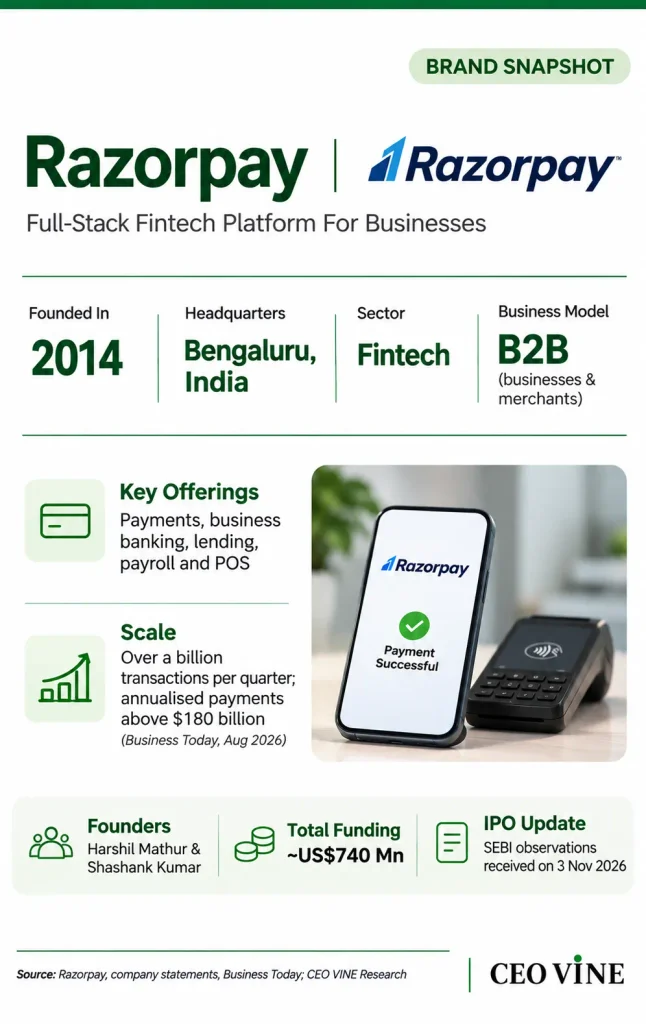
- Razorpay was founded in 2014 by IIT Roorkee alumni Harshil Mathur and Shashank Kumar after they identified the difficulty businesses faced in accepting online payments.
- The company has expanded from a payment gateway into a financial technology platform offering payments, RazorpayX, payroll, lending, POS and cross-border services.
- Razorpay reported FY25 consolidated revenue of ₹3,783 crore, up 65% year-on-year, but recorded a loss of approximately ₹1,209 crore, largely attributed to ESOP and reverse-flip-related costs.
- After receiving SEBI’s observations in November 2026, Razorpay is moving closer to its proposed IPO, with reports indicating a potential ₹5,000–6,000 crore issue and an estimated $5 billion valuation.
Razorpay began with a problem that its founders encountered while building a crowdfunding platform: accepting payments online in India was far more difficult than building the platform itself. Harshil Mathur and his college friend Shashank Kumar found that businesses, particularly early-stage startups, struggled to integrate online payment systems. What started as an attempt to solve that problem in 2014 has since grown into one of India’s largest fintech companies.
Headquartered in Bengaluru, Razorpay now provides payment acceptance, payouts, business banking solutions, payroll, merchant lending, point-of-sale services and other financial products. The company has also expanded into artificial intelligence (AI)-powered payment infrastructure and agentic commerce.
According to figures shared by CEO Harshil Mathur in 2026, Razorpay processes more than one billion transactions every quarter and handles annualised payment volumes exceeding $180 billion. It is also preparing for a public market listing after receiving observations from the SEBI on its confidential IPO filing in November 2026.
How Razorpay Started
The idea behind Razorpay emerged when Mathur and Kumar were working on a crowdfunding platform. While developing the product, they realised that collecting payments online was one of the biggest obstacles for businesses. Conversations with founders in Bengaluru and Pune revealed that the problem was widespread, with some businesses even considering cash-based alternatives.
Mathur, a mechanical engineering graduate from IIT Roorkee, had initially taken up a job at Schlumberger in Abu Dhabi. However, his interest in technology and building products eventually led him towards entrepreneurship. Along with Kumar, also an IIT Roorkee alumnus, he began exploring different business ideas before identifying online payments as a larger opportunity.
The founders decided to build a payment gateway from the merchant’s perspective, particularly for startups and small businesses that were underserved by existing providers.
Building the business was not straightforward. Mathur has recalled approaching nearly 100 bankers over three to six months to understand the requirements for setting up a payments company. The founders faced repeated rejections, but the conversations helped them understand the regulatory and operational complexities of the industry.
Their approach eventually attracted Y Combinator, which accepted Razorpay into its Winter 2015 batch. The company initially started in Jaipur before moving to Bengaluru to be closer to India’s growing startup ecosystem.
Instead of competing directly for large enterprise clients, Razorpay focused on smaller businesses that needed a simple way to collect payments online. The strategy allowed it to build relationships with startups as they expanded.
Mathur has said that companies such as Groww, Meesho and Zepto processed some of their earliest transactions through Razorpay. The company has also reported serving 105 of India’s 119 unicorns, highlighting its reach across the startup ecosystem.
Another important development came with the growth of the Unified Payments Interface (UPI). Razorpay was among the early payment gateways to support UPI after its launch in 2016. This helped the company participate in the rapid shift towards real-time digital payments in India.
Razorpay Business Model
Payment processing remains central to Razorpay’s business model. The company earns revenue by facilitating transactions for merchants and has expanded its product portfolio around the financial workflows that businesses manage after receiving payments.
As its merchant base grew, Razorpay identified additional requirements beyond payment collection. Businesses needed to transfer money to vendors, employees, gig workers and other partners, while managing payroll, reconciliation and working capital.
These requirements led to the development of RazorpayX, its business banking and financial management platform. Payroll products followed, alongside corporate cards, payouts, payment links, payment pages and point-of-sale solutions.
The company also offers Magic Checkout, which aims to simplify the online checkout process, and Razorpay Capital, through which businesses can access working capital and lending products.
The strategy is to serve multiple financial requirements through a connected platform. A merchant using Razorpay for payment acceptance, payouts, payroll and other financial services may have fewer reasons to shift to another provider. It also gives Razorpay opportunities to generate revenue from a broader set of services.
Razorpay has expanded its capabilities through acquisitions. In 2019, it acquired Thirdwatch, an artificial intelligence-based fraud prevention startup, and Opfin, a payroll and finance automation company.
In 2022, it acquired Malaysian payments company Curlec to strengthen its Southeast Asian presence. It also acquired Ezetap, expanding into offline point-of-sale payments, and PoshVine, a customer loyalty and rewards platform.
These acquisitions helped Razorpay expand beyond online payment acceptance into fraud prevention, payroll, offline payments, loyalty and international markets.
Razorpay Funding and Valuation
Razorpay’s early investors included Y Combinator, Tiger Global and Matrix Partners India, now known as Z47. The company raised several funding rounds as it expanded its product portfolio and merchant network.
In June 2019, Razorpay raised $75 million in a Series C round. In October 2020, it secured $100 million in a Series D round led by GIC and Sequoia Capital India, now Peak XV Partners, achieving unicorn status.
Its valuation increased further in 2021. A $160 million funding round in April 2021 valued the company at approximately $3 billion. In December that year, Razorpay raised $375 million in a Series F round co-led by Lone Pine Capital, Alkeon Capital and TCV, taking its valuation to $7.5 billion.
The $7.5 billion valuation remains its last widely reported peak private-market valuation. Reports around its proposed IPO in 2026 have indicated a potential valuation of approximately $5 billion, although the final valuation will depend on the public offering and market conditions.
Razorpay Revenue and Profitability
Razorpay reported consolidated revenue of ₹3,783 crore in FY25, representing a 65% increase from ₹2,296 crore in FY24. Gross profit increased 41% to ₹1,277 crore from ₹906 crore in the previous financial year.
However, the company reported a consolidated loss of approximately ₹1,209 crore in FY25. Razorpay attributed the loss largely to employee stock ownership plan (ESOP)-related expenses, restructuring costs and tax liabilities associated with its reverse flip, through which its parent company’s domicile shifted from the United States to India in 2025.
The reported loss needs to be viewed alongside the company’s revenue growth and the expenses associated with the restructuring. However, it remains an important financial metric that public market investors are likely to examine.
Mathur has previously said that Razorpay’s core online payments business is EBITDA-profitable and generates strong cash flows. This statement relates to the core payments business and should not be interpreted as the entire company being profitable on a consolidated basis.
The company’s FY26 financial statements had not been publicly disclosed at the time of this update. Its next set of financial disclosures will be important in assessing whether revenue growth is translating into improved overall profitability.
Razorpay and AI
Razorpay has increasingly positioned AI as part of its payments and financial technology strategy. Its work in this area includes payment intelligence, transaction routing, fraud detection, checkout personalisation and agentic commerce.
In October 2025, Razorpay worked with NPCI and OpenAI on a pilot for agentic payments, allowing users to discover products and complete purchases through conversational AI experiences using UPI-based payment infrastructure. The company later expanded its work in agentic commerce through a collaboration with NPCI and Anthropic’s Claude, with businesses such as Zomato, Swiggy and Zepto involved in the pilot.
In August 2026, Razorpay launched Vulcan, its AI foundation model built specifically for payments. The company said the model was trained on nearly four billion payments and three trillion data points. It is designed to support transaction routing, fraud detection, risk assessment and checkout personalisation.
Razorpay has also expanded its work with OpenAI into advertising. In October 2026, the company partnered with OpenAI to help Indian brands advertise on ChatGPT through Razorpay Engage. The platform is designed to support product catalogue preparation, campaign setup, optimisation and performance tracking. This is a separate commercial use case from the earlier agentic payments collaboration.
These developments indicate that Razorpay is looking beyond conventional payment processing. By combining payment infrastructure with AI-driven tools, the company is seeking to participate in emerging commerce models in which consumers discover products, make decisions and complete transactions through conversational interfaces.
Razorpay IPO 2026
Razorpay filed confidential IPO papers with SEBI in June 2026 as part of its plans to enter the public markets. The company received SEBI’s observations on 3 November 2026, moving the proposed offering closer to the next stages of the listing process.
Reports have estimated that the company could raise between ₹5,000 crore and ₹6,000 crore through the public issue, with a potential valuation of around $5 billion. The proposed issue has been reported to include a combination of fresh shares and an offer for sale (OFS), although the final structure has not been disclosed.
The IPO process follows Razorpay’s reverse flip in May 2025, when it shifted its parent company’s domicile from the United States to India. The company also converted into a public limited entity as part of its preparations for a domestic listing.
For a more detailed update on the proposed issue, including the reported valuation and regulatory developments, read our coverage of Razorpay receiving SEBI observations for its ₹6,000 crore IPO.
The proposed listing will bring greater scrutiny of Razorpay’s revenue growth, operating profitability, payment volumes and ability to scale its newer businesses. Its valuation will also be assessed against the performance of other fintech and payments companies.
FAQs
Who founded Razorpay?
Razorpay was founded in 2014 by Harshil Mathur and Shashank Kumar, both alumni of IIT Roorkee. Mathur is the company's CEO and Kumar is its co-founder and managing director.
What does Razorpay do?
Razorpay is an Indian fintech company offering payment gateway services, online and offline payment acceptance, payouts, business banking through RazorpayX, payroll, merchant lending, point-of-sale devices and cross-border payment solutions.
How does Razorpay make money?
Razorpay primarily earns through fees charged for processing payments. It also generates revenue from services such as payouts, payroll, point-of-sale solutions, lending-related products, loyalty programmes and international payments.
What is RazorpayX?
RazorpayX is the company's business banking and financial management platform. It offers services such as payouts, payroll, corporate cards and other tools that help businesses manage financial operations.
What was Razorpay's highest valuation?
Razorpay reached a valuation of $7.5 billion in December 2021 after raising $375 million in its Series F funding round. Reports around its proposed 2026 IPO have indicated a potential valuation of approximately $5 billion.
Is Razorpay profitable?
Razorpay reported consolidated revenue of ₹3,783 crore and a loss of approximately ₹1,209 crore in FY25. The company attributed the loss largely to ESOP-related expenses, restructuring costs and tax liabilities associated with its reverse flip. Its management has said the core online payments business is EBITDA-profitable.
Which companies has Razorpay acquired?
Razorpay's acquisitions include Thirdwatch and Opfin in 2019, followed by Curlec, Ezetap and PoshVine in 2022. These acquisitions expanded its capabilities in fraud prevention, payroll, international payments, offline payments and customer loyalty.
When is Razorpay's IPO?
Razorpay received SEBI's observations on its confidential IPO filing on 3 November 2026. Reports have indicated a potential listing in 2027, but the company has not announced a final issue date, price band or listing schedule.


