



This Indian Mother Built A Free Learning Website In 2010. 15 Years Later, It Still Helps Millions of Children Learn
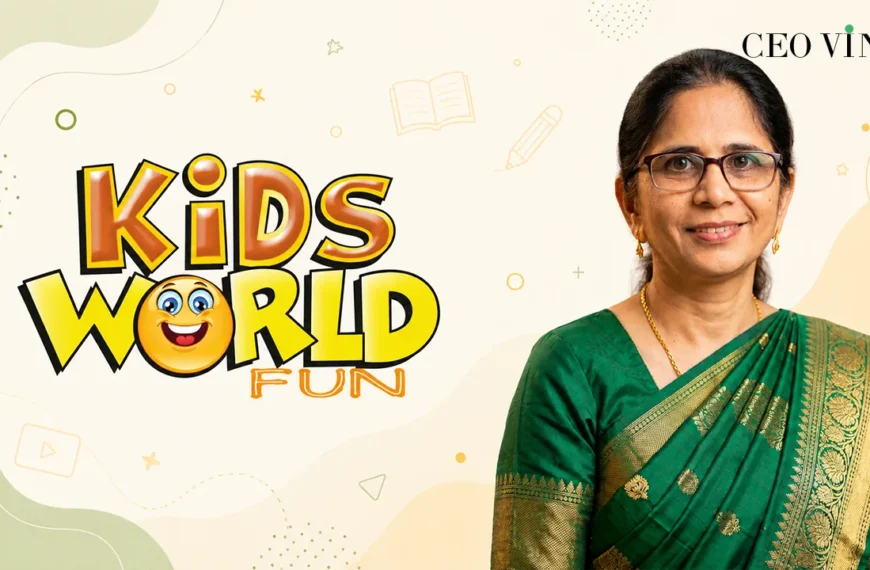
Leela M launched KidsWorldFun.com in January 2010, initially with short stories, poems, and educational videos, and grew it category by category as users arrived and told them what else they needed.


Before Byju’s became a billion-dollar brand. Before Unacademy raised hundreds of crores. Before the Indian edtech boom turned children’s digital learning into a venture capital race, a parent in Kochi sat down at her computer and started building something the internet did not yet have: a single, free, safe, and genuinely enjoyable place where children could learn.
That parent was Leela M. The year was 2010. And the platform she built with her husband Mohan Das, Kids World Fun, is still running today, still free, still bootstrapped, and still serving millions of children, parents, and teachers across the world from the same base in Kerala from which it was launched fifteen years ago.
In an era when the Indian edtech industry is defined by funding rounds, valuations, and acquisition headlines, Kids World Fun is a different kind of story: one built not on investor capital but on a mother’s frustration, a family’s effort, and a consistent 15-year commitment to making quality children’s learning content accessible to anyone with a browser.
The Problem A Parent Could Not Find An Answer To
The founding insight behind Kids World Fun came from a place most product ideas do not: personal inconvenience with no commercial angle.
“Around 20 years ago, as a parent of young children, I was searching for free, fun, and educational resources for my kids,” Leela shares her experience with CEO VINE that led to the platform. “Although I found many useful websites, I couldn’t find a single platform that offered everything I needed in one place. That experience inspired me to create Kids World Fun, a safe, engaging, and comprehensive resource for children, parents, and teachers.”
The gap she identified was both obvious and oddly unaddressed. Parents in 2010 could find children’s stories on one website, printable worksheets on another, educational videos on a third, poems somewhere else entirely. Each visit meant a new set of navigation decisions, a new trust assessment, and a new exposure risk for a parent trying to let a child browse independently. No single destination existed that covered all of these categories in one place, at a level of safety and quality that a parent could trust without needing to monitor every click.
Leela built that destination. Mohan Das, who brought the technical expertise to her educational background, built and maintained the infrastructure behind it. Together, they launched KidsWorldFun.com in January 2010, initially with short stories, poems, and educational videos, and grew it category by category as users arrived and told them what else they needed.

15 Years Of Building What Children Actually Need
The platform that exists today is considerably broader than the one that launched in 2010. Kids World Fun now hosts stories, poems, worksheets, grammar guides, games, quizzes, riddles, jokes, eBooks, animated content, English learning resources, and activity materials spanning every major subject area relevant to K-12 learning. Every piece of content is structured in English, giving the platform a global reach that goes well beyond its Kerala origins, serving families and classrooms in countries where English-medium education is either the standard or an aspiration.
What has not changed is the founding commitment to keeping it free. In a market where most edtech platforms have moved aggressively toward subscription models, paywalled content, and freemium structures, Kids World Fun remains openly and entirely accessible without registration or payment. The platform monetises through an indirect advertising model, generating revenue through display advertising rather than from the children, parents, or teachers it serves.
That model has required a specific kind of discipline. Without the ability to raise a funding round to cover operating costs during a slow traffic period, or to hire a marketing team to run paid acquisition campaigns, every decision about content, quality, and user experience has had to be made within the constraints of what the platform itself generates.
“The biggest lesson has been that quality and trust matter more than quantity,” Leela has said of what fifteen years of running Kids World Fun has taught her. “Building long-term credibility takes consistency, patience, and continuous improvement.”
The Market They Were Serving Before It Had A Name
When Kids World Fun launched in 2010, the concept of a structured Indian edtech market barely existed. Byju’s, now the country’s most recognised edtech brand despite its recent financial difficulties, was still primarily a coaching centre. Most edtech investment was either in the United States or in enterprise learning tools with no direct relevance to children’s content.
India’s online education market was valued at approximately $3.64 billion in 2025 and is projected to reach $23.9 billion by 2034, growing at a CAGR of 23.28%, according to IMARC Group. K-12 learning dominates the edtech market with a 43% share in 2025, driven by a student population that is both enormous in scale and increasingly digital in its learning habits. India’s broader edtech market was valued at $7.5 billion in 2025, fuelled by 950 million internet users and a 250 million student base.
Kids World Fun was building for this audience 15 years before these numbers arrived. The platform’s founding insight, that parents needed a single trusted destination for free children’s educational content, has only become more commercially validated with time, even as the edtech industry has moved toward subscription models, app-first experiences, and AI-powered personalisation that the Kids World Fun model largely predates.
The platform’s global reach, serving children and educators across countries where English is either a primary or aspirational medium of instruction, gives it a footprint that many venture-funded Indian edtech platforms with far more capital have struggled to match. Organic search traffic, built across fifteen years of consistent content creation and genuine user utility, functions as a distribution channel that no advertising spend can fully replicate.

A Lean Team, A Trusted Community
Kids World Fun operates with a team of content writers, editors, designers, developers, and SEO specialists, a lean structure for a platform serving millions of users across subject areas spanning language, mathematics, science, creative writing, and general knowledge. The content creation and editorial process prioritises age-appropriate language, curriculum alignment, and what the founders describe as a learning experience that combines educational value with genuine enjoyment.
“Every piece of content is designed to be both educational and enjoyable,” Leela has explained of the platform’s editorial philosophy. “We combine learning objectives with storytelling, games, quizzes, and creative activities so children learn naturally while having fun.”
The platform’s user base spans 3 distinct but equally important groups: children as the primary users, parents who use it as a trusted at-home resource, and teachers who incorporate its worksheets and learning materials into classroom instruction.
User feedback has shaped the platform meaningfully over fifteen years. Categories including games, quizzes, eBooks, and specific subject-area worksheets were added in direct response to requests from parents and teachers who had already found value in the platform’s original story and poem content and wanted more. That feedback loop, between a small editorial team and a large, globally distributed user community, has functioned as the platform’s most reliable product development mechanism.
What Comes Next
Kids World Fun’s roadmap for the next phase of its journey reflects both the maturity of a fifteen-year-old platform and the ambitions of a founding team that has never stopped building. Mobile applications are a near-term priority, addressing a gap the founders acknowledge openly: “We would invest earlier in mobile experiences, interactive learning tools, and multilingual content to reach even more children worldwide,” Leela has said in reflecting on what she would do differently if starting over. School partnerships, digital learning products, and new educational collaborations are also being explored.
The vision the founders articulate for where Kids World Fun sits in five years is direct: one of the world’s leading free educational platforms for children, reaching more families, schools, and classrooms globally with learning experiences that remain, as they have been since 2010, free to access and safe to use.
That ambition, in the context of an Indian edtech market that has seen enormous amounts of capital deployed, significant brand-building, and more than a few high-profile failures, carries a particular kind of credibility. Kids World Fun did not raise a Series A and then discover that children’s learning content is hard to monetise at scale. It built a model that works within its constraints over fifteen years, serving real users, generating real revenue, and doing something that the most funded companies in its category have sometimes forgotten to prioritise: making something parents actually trust.
Kids World Fun is headquartered in Kochi, Kerala, India. The platform is freely accessible at kidsworldfun.com.