



The Platform Playbook: How India’s EV Scooter Makers Are Actually Competing in 2026


Between late July and early September 2026, India’s electric scooter market saw an unusually tight cluster of launches. TVS rolled out the iQube ST. Ather introduced the Konarc. Simple Energy launched the Wave. Each was covered as a standalone product story, another new scooter, another spec sheet, another price point. That framing misses what’s actually happening underneath it. These aren’t just new models. They’re the visible output of a manufacturing strategy that has quietly become the real dividing line between which EV two-wheeler companies are scaling profitably and which ones are still burning cash trying to catch up.
The Numbers Everyone’s Reporting, and the Question They Don’t Answer
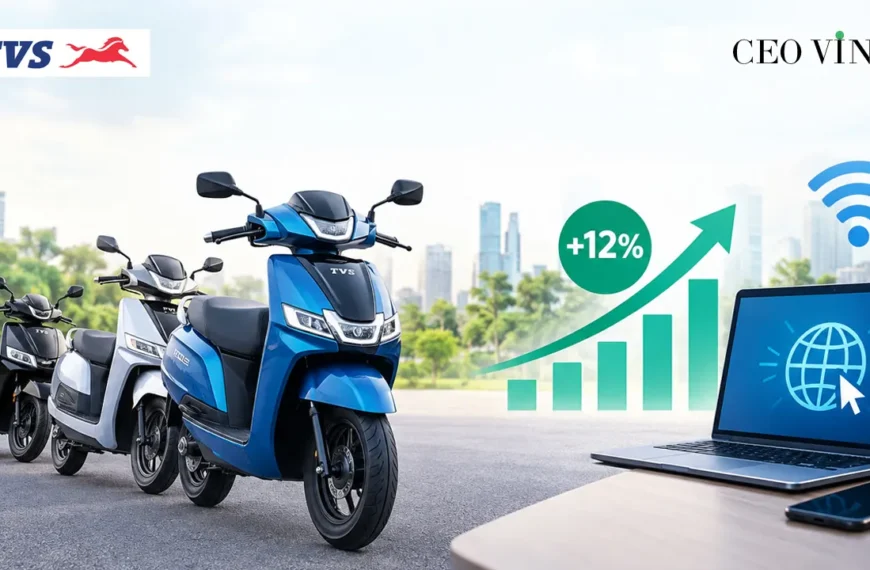
By August 2026, TVS Motor Company had captured roughly 26% of India’s electric two-wheeler market on a cumulative January-to-August basis, according to Vahan registration data, with Bajaj Auto close behind at 22% and Ather Energy holding 17%. Hero’s Vida brand sat around 11%, while Ola Electric, the company that led this category outright as recently as 2024, had fallen to a single-digit share. TVS and Bajaj together now account for roughly half of every electric scooter registered in the country.
Most coverage of this shift stops at “legacy manufacturers have distribution and trust that startups lack,” which is true but incomplete. Distribution explains why an established brand can sell more scooters once it has a good one. It doesn’t explain why TVS, Bajaj, Ather, and now Simple Energy have all converged on the same underlying design decision in 2026, building one scalable chassis and offering it across a spread of battery sizes and price points, rather than engineering a new scooter from scratch for every price segment.
What a “Platform” Actually Means Here
Ather’s Konarc, launched at its Annual Community Day in late August 2026, is the clearest example of this strategy stated outright. It’s the first product built on Ather’s new EL platform, a chassis explicitly designed to prioritise lower manufacturing cost, simpler servicing, and easier charging over the performance-first engineering that defined Ather’s earlier 450 series. The Konarc ships in three variants, S 100, S 125, and S 161, each named for its certified range, built around the same physical platform but fitted with progressively larger battery packs: 2.1 kWh, 2.7 kWh, and 3.5 kWh respectively. Pricing scales cleanly with that battery size, from ₹99,999 for the base variant to ₹1,44,999 for the top one, with a 200 km range version and a feature-loaded Z line still to come on the same underlying architecture.
The commercial logic is straightforward once you see it laid out. Ather doesn’t need to design, tool, and certify three separate scooters to serve three separate price points. It designs one platform once, then varies the single most expensive component, the battery, to hit different customers. Simple Energy’s Wave, launched days later, follows the identical playbook: three core variants spanning six models, with battery options running from 2.2 kWh up to 5.0 kWh, all built on one chassis, one seat, one storage architecture. TVS has run this approach longest with its iQube lineup, which now spans from an entry variant to the premium iQube ST with a 5.3 kWh pack, all sharing a common platform that TVS has iterated on since the model’s original launch. Bajaj’s Chetak follows the same pattern across its five current variants.
Ola Electric’s own response arrived within days of Ather’s Konarc, and it’s worth reading closely because it shows the same platform logic being applied by the one major player whose earlier strategy hadn’t relied on it. The new Ola S1 Z, launched in two variants, comes with a 3.1 kWh battery priced at ₹79,999 with a claimed 179 km range, and a larger 5.1 kWh pack at ₹99,999 rated for 301 km, both sharing the same 4 kW motor and 70 km/h top speed. The bigger shift is under the skin: Ola built the S1 Z around its own indigenously developed Bharat Cell LFP battery technology, manufactured at its Tamil Nadu Gigafactory, a vertical-integration bet aimed squarely at controlling the one cost line, cell manufacturing, that every other platform strategy in this article is built around varying. Just as tellingly, the S1 Z is the first Ola model sold through dealer-operated stores rather than the company-owned outlets Ola had relied on until now, a direct concession to exactly the distribution and service-trust gap discussed below. Deliveries are staggered, December 2026 for the base variant and March 2027 for the larger one, which suggests Ola is still catching up operationally even as its product strategy starts to converge with its rivals’.
Why This Is the Thing That Actually Determines Who Wins
Every scooter company in this market is chasing the same customer, an urban commuter who wants a family-practical scooter somewhere between ₹80,000 and ₹1.5 lakh. A platform strategy is what lets a manufacturer serve that entire price band profitably, because the expensive, hard-to-change parts of the vehicle, the frame, the motor mounting, the storage architecture, the safety systems, get engineered once and amortised across every variant sold. The part that actually varies with price, the battery, is also the part where cell costs have fallen fastest as India’s domestic battery supply chain has matured through 2025 and 2026, meaning the highest-margin lever in the entire vehicle is exactly the one a platform approach lets a company adjust most cheaply.
This is also, not coincidentally, where Ola Electric’s stumble becomes easier to explain in strategic rather than purely reputational terms. Ola built its early lead on aggressive pricing and a large retail footprint, but its product architecture and after-sales network never matured into the kind of scalable, serviceable platform that TVS, Bajaj, and now Ather have converged on. Persistent service complaints compounded a manufacturing approach that hadn’t been built around long-term serviceability from the start, and the company’s 2026 response, the new S1 Z, its Bharat Cell battery push, and its first-ever move toward dealer-operated retail, shows Ola playing catch-up on the exact fronts, platform economics and distribution trust, that its rivals had already converged on months earlier.


The Trust Infrastructure Nobody Talks About Enough
Platform economics explain why these companies can price competitively across a range. They don’t fully explain why TVS and Bajaj specifically have pulled ahead of Ather in raw volume despite comparable platform thinking. That answer sits in physical infrastructure rather than product design. TVS and Bajaj inherited decades of dealership and service-centre density built for their combustion-engine businesses, infrastructure an EV-first startup simply cannot replicate in a few years regardless of capital raised. When a customer is choosing between two similarly priced, similarly specced electric scooters, the deciding factor is increasingly whether there’s a trusted service centre within a reasonable distance, not which brand has the flashier app or the longer feature list. Ather’s own expansion, and its recent shift toward a lower-cost, easier-to-service platform with the Konarc, reads as a direct response to this exact gap.
What This Means for Buyers, and for Founders Watching This Space
For a consumer shopping in this category, the practical takeaway is that price differences across brands increasingly track battery size and range rather than fundamental engineering quality, since most competitors are now building on some version of the same platform logic. The more useful comparison isn’t which scooter looks newest, it’s total cost of ownership: battery warranty length, real-world range versus claimed IDC figures, and proximity to a service centre.
For founders and operators watching this category as a case study, the lesson travels well beyond two-wheelers. A platform strategy, one flexible core product with the expensive, hard-to-change parts engineered once, and the customer-facing variation concentrated in the single component that’s getting cheaper fastest, is a genuinely transferable playbook for any hardware or physical-product business trying to serve a wide price range without multiplying manufacturing complexity. India’s EV scooter market in 2026 isn’t just a story about who’s winning. It’s a live demonstration of why that kind of platform thinking, not just product launches or funding rounds, is what eventually separates a scaling manufacturer from one still reacting to the market around it.