



The Byju’s Collapse: Inside India’s Most Dramatic Startup Implosion
In 2022 Byju's was India's most valuable startup at $22 billion. By 2024 the founder admitted it was worth zero.


The place to start is not the beginning. It is the IHOP.
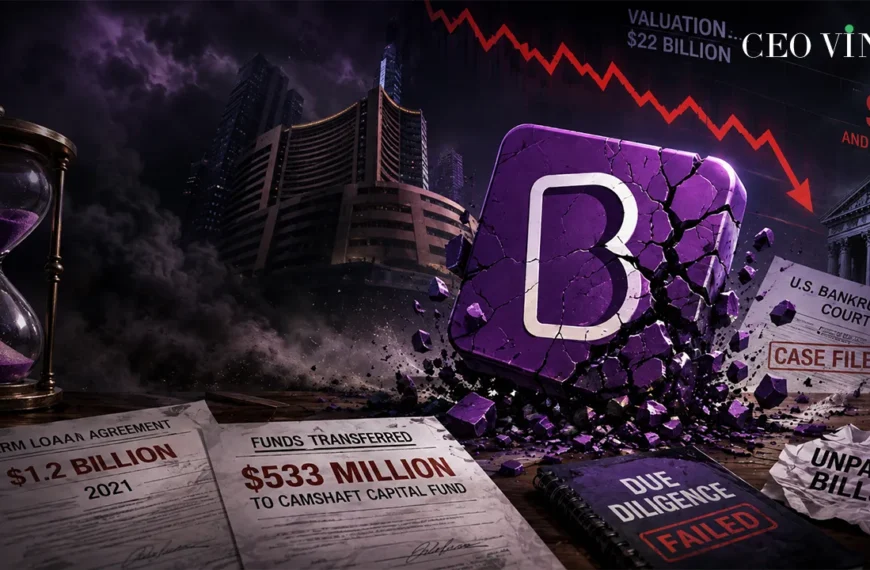
In Wilmington, Delaware, a U.S. bankruptcy court was working through a case involving Byju’s Alpha Inc., the American subsidiary of India’s most valuable startup. The creditors, institutional lenders who had extended a $1.2 billion term loan in 2021, were trying to recover their money.
What they alleged they found was this: $533 million of the $1.2 billion loan had been siphoned to Camshaft Capital Fund, a hedge fund once registered at the address of an International House of Pancakes restaurant in Miami. Camshaft was run by a 23-year-old with seemingly no relevant educational or professional experience, who had purportedly spent part of the funds on a Ferrari, a Lamborghini, and a Rolls-Royce.
The company behind this allegation had, two years earlier, been celebrated on the cover of every major Indian business publication. It had raised $5.8 billion in total funding. It was backed by Sequoia, Silver Lake, Tiger Global, and the Qatar Investment Authority. Its founder was on the National Startup Advisory Council of India. He had been called the most important entrepreneur in Indian education.
This is the story of how the distance between those two things, the magazine cover and the IHOP hedge fund was travelled. And it is a longer, stranger, and more instructive journey than most people realise.
A Village in Kerala, a Physics Teacher’s Son
Byju Raveendran was born in 1980 in Azhikode, a coastal village in Kerala. His parents were both dedicated teachers, his father specialising in physics, his mother in mathematics.
Growing up watching teachers at work every day, Raveendran absorbed something specific about the act of explaining. Not the formal, textbook version of explaining but the intuitive, student-first version. The kind that starts from what the student already understands and builds forward, rather than from what the curriculum demands and works backward.
He was not a conventional academic achiever. He achieved a perfect score twice in the CAT exam. However, he chose not to attend any IIM. That choice, scoring 100 percentile in India’s most competitive management exam and walking away from the IIM system tells you something important about how Raveendran related to formal institutional authority.
After completing his B.Tech from Government College of Engineering, Kannur, Byju joined a multinational shipping company as a service engineer. In 2003, during a holiday break, he helped some friends prepare for CAT. He sat the exam himself alongside them, scored 100 percentile, and something clicked.
He started with 100 students. Those 100 became 1,000, then more. He moved from small rooms to auditoriums. From auditoriums to cinema halls. From cinema halls to cricket stadiums. Thousands of students sitting in stadium seating to attend a mathematics class. There was nothing quite like it in Indian education, a rock concert atmosphere for exam preparation.
Divya Gokulnath, who would later co-found Byju’s, was one of his students. She used to stay back after class to ask questions. “It’s very difficult to notice any particular student in a stadium. She used to stay back and ask a lot of questions so she got noticed, and I don’t know when it changed and we became life partners,” Raveendran later said. They married in 2009.
In 2007, he formally launched Byju’s Classes. In 2011, he and Divya incorporated Think and Learn Private Limited, the entity that would become the parent company of everything that followed.
Building the App: 2015 to 2018
The Byju’s learning app launched in 2015, designed by Raveendran himself for student learning on handheld devices. It offered video-based lessons for students in classes 4 through 12, with Raveendran’s own teaching style translated into content, visual, energetic, intuitive, and anchored in real-world examples rather than textbook abstraction.
The product was genuinely strong. This is important to establish before the collapse is examined, because the temptation in retrospect is to suggest the failure was always inevitable. It was not. Byju’s built something real. Former students who watched Raveendran teach recalled being awestruck. “It was easy to get wowed by his persona,” one former executive told Rest of World. “When you’re sitting in his class, the guy is teaching you math in a way that it has never been brought to you. You’ll be amazed.”
By 2018, 15 million students had registered on the platform and 900,000 were paid subscribers. Revenue was growing over 100% annually. Chan Zuckerberg Initiative invested, valuing the company at $1 billion. India had its first edtech unicorn.
Then, between 2019 and 2022, something changed. The company stopped behaving like an educational product and started behaving like a financial instrument.
The Acquisition Machine: Buying Everything in Sight
The pace of acquisitions between 2019 and 2022 was extraordinary and, in hindsight, disqualifying.
Aakash Educational Services for $950 million. Great Learning for $600 million. Toppr for $150 million. Epic, the American children’s reading platform, for $500 million. Tynker, a kids’ coding platform, for $200 million. Gradeup, rebranded Byju’s Exam Prep. WhiteHat Jr., a kids’ coding startup, for $300 million.
Byju’s expanded too fast, acquiring startups, entering international markets, and spending heavily on celebrity endorsements and sponsorships. This rapid growth became difficult to sustain, especially after pandemic-driven demand for online learning began to fade.
Each acquisition required integration work, management bandwidth, and financial resources. None of these acquisitions was given the time needed to be properly integrated before the next one arrived. The company’s culture, product coherence, and operational discipline were stretched across dozens of entities, markets, and business models simultaneously.
The Aakash acquisition was the most consequential and the most revealing. Byju’s was a digital, asset-light learning platform. Aakash was a traditional offline coaching business with physical centres, face-to-face teaching, and a model built entirely around physical infrastructure. The two businesses were not complementary, they were structurally different. Integrating them at speed, while simultaneously acquiring international platforms in entirely different markets, was not a product strategy. It was a valuation strategy: buying revenue to justify the $22 billion figure investors were attaching to the business.
The Numbers Nobody Was Allowed to See
The first serious signal that something was wrong arrived not with a scandal but with an absence. Byju’s repeatedly delayed filing its audited financial statements.
For FY2021, results were published 18 months late, in September 2022. When they arrived, they showed a net loss of ₹4,564 crore, a figure that had been hidden from public view while the company was simultaneously raising capital, making acquisitions, and signing a $1.2 billion term loan in the United States.
Byju’s posted FY22 results after a 22-month delay. Net loss had ballooned to Rs 8,245 crore.
Then came June 2023. Deloitte resigned as Byju’s auditor, citing unresolved disagreements over the accounts. Within days of the auditor’s resignation, 3 board members resigned simultaneously, representatives of Prosus, Peak XV Partners, and Chan Zuckerberg Initiative. The investors who had written the largest cheques were walking out of the boardroom.
In corporate governance, an auditor resignation is a serious signal. Three simultaneous board member resignations following it is an unambiguous one. The people with the most information about what was actually happening inside Byju’s were choosing to no longer be associated with it.
Raveendran found himself with a board of three: himself, his wife Divya Gokulnath, and his brother Riju Raveendran.
The $533 Million and the Miami Hedge Fund
The $1.2 billion term loan raised in 2021 through Byju’s Alpha, the company’s American subsidiary, was the largest debt raise in Indian edtech history. The lenders were sophisticated institutional investors. The loan was secured against assets and came with standard covenants around how the money could be used.
In March 2022, Byju’s Alpha defaulted on those covenants.
What happened next is the detail that separates the Byju’s case from ordinary corporate financial distress.
$533 million of the loan proceeds were transferred to Camshaft Capital Fund, a hedge fund that had been registered at the address of an International House of Pancakes restaurant in Miami. Camshaft was operated by a 24-year-old named William Morton, with no relevant educational or professional experience in fund management. Part of the funds were reportedly used to purchase a Ferrari, a Lamborghini, and a Rolls-Royce.
In a landmark ruling delivered on February 28, 2025, Judge John T. Dorsey of the U.S. Bankruptcy Court for the District of Delaware found Byju’s Alpha Inc., its director Riju Raveendran, Think and Learn Pvt Ltd, and Camshaft Capital Fund guilty of fraudulent transfers and financial misconduct.
The Delaware bankruptcy judge subsequently issued a default judgment after finding that Byju Raveendran had repeatedly ignored court orders and provided “evasive, incomplete” responses regarding the $533 million. The total default judgment against him personally was set at over $1.07 billion.

The Indian Side: ED, NCLT, and BCCI
While American courts were processing the Delaware proceedings, Indian regulatory and legal bodies were moving simultaneously across multiple fronts.
The Enforcement Directorate opened a probe under the Foreign Exchange Management Act for alleged violations in foreign remittances. A lookout notice was issued for Raveendran, preventing him from leaving India, he later left anyway, citing his father’s medical treatment in Dubai, and has remained outside the country since.
The Board of Control for Cricket in India filed a case over unpaid dues from Byju’s shirt sponsorship of the Indian cricket team, a sponsorship that had been one of the most visible signals of the company’s ambition and, in retrospect, its spending excess.
On February 1, 2024, Byju’s U.S. division filed for Chapter 11 bankruptcy in Delaware. The National Company Law Tribunal admitted an insolvency petition against Think and Learn Private Limited under the Insolvency and Bankruptcy Code, appointing an Interim Resolution Professional to take charge of operations.
Byju’s would attempt to raise around $200 million to clear immediate liabilities, at a post-money valuation of $225 million. The company that had been valued at $22 billion was now attempting to raise money at $225 million, a 99% valuation collapse.
Byju Raveendran himself acknowledged the scale of what had happened: “Investors leaving board was biggest setback; Byju’s now worth zero.”
Also Read: BYJU’S founder Byju Raveendran sentenced to 6 months jail by Singapore court
The Human Cost Behind the Headlines
The legal proceedings and valuation figures have a way of absorbing attention that can obscure the most important part of the Byju’s collapse: the human beings on whom it fell.
At peak employment, Byju’s had over 50,000 employees across India and internationally. The company went through multiple rounds of mass layoffs, over 10,000 job cuts across 2022 and 2023, affecting engineers, teachers, sales staff, and support workers who had joined what appeared to be India’s most important technology company.
Students and families who had paid substantial sums for multi-year learning subscriptions found services disrupted and content inaccessible as operations deteriorated. The company’s aggressive, high-pressure sales tactics which became the subject of widespread media coverage and consumer complaints had already drawn scrutiny. The collapse compounded those grievances into something more systemic.
For the broader Indian startup ecosystem, the Byju’s collapse had a chilling effect that lasted through 2023 and 2024. Investor diligence became more rigorous. Governance requirements tightened. The idea that charismatic founders with compelling visions should be trusted with capital without robust independent oversight became significantly harder to sustain.



Where Things Stand Today
In April 2025, a group of creditors sued Byju Raveendran, his wife Divya Gokulnath, and executive aide Anita Kishore in their personal capacities, alleging they had executed a scheme to conceal hundreds of millions of dollars in loan funds. The Byju’s officials denied the allegations.
Insolvency proceedings against Think and Learn continue before the NCLT in India. The Delaware bankruptcy court default judgment of $1.07 billion against Raveendran personally is under appeal. The $533 million has not been recovered. Raveendran is outside India.
What Byju’s leaves behind is complicated. It leaves behind thousands of former employees building careers elsewhere. It leaves behind students whose learning was disrupted at critical academic moments. It leaves behind a cautionary note in every subsequent Indian startup funding conversation about governance, financial transparency, and the danger of growth narratives that are not anchored in verifiable underlying economics.
It also leaves behind the irony of its own founding story. A teacher from a village in Kerala who filled cricket stadiums because he genuinely could make mathematics click in a way that no textbook could, that story was real. The teaching was real. The product, at least in its early years, was real.