



10 Indian Climate Tech Startups Powering India’s Energy Transition (2026 List)
India's climate tech sector has crossed $12.8 billion in cumulative funding across 1,583 companies. Here are 10 startups building the country's green energy transition in 2026.


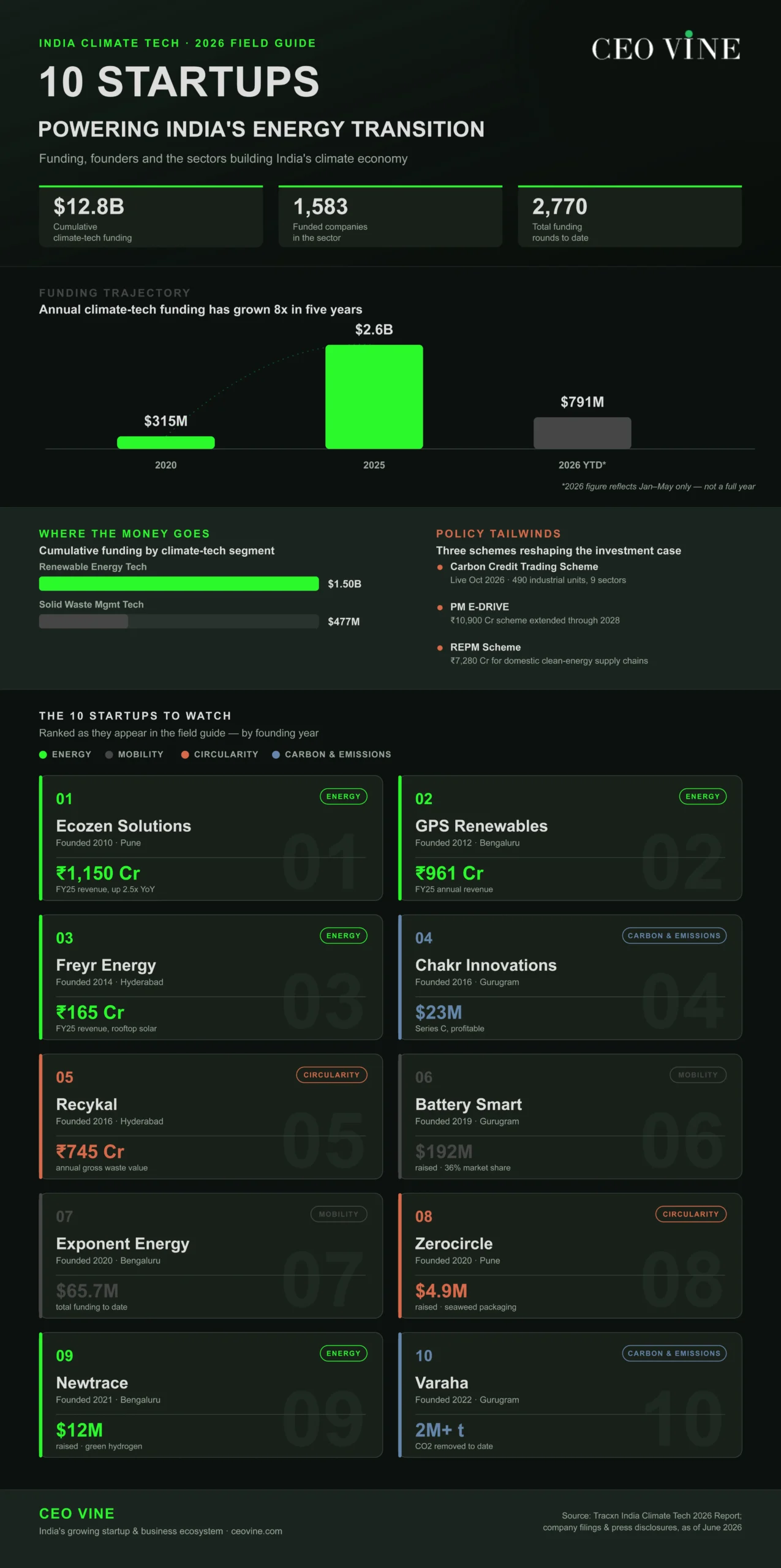
India’s climate tech sector has quietly become one of the most capitalised corners of its startup economy. Annual funding has climbed from $315 million in 2020 to $2.6 billion in 2025, and the sector has now crossed $12.8 billion in cumulative funding across 1,583 funded companies and 2,770 rounds, according to Tracxn’s India Climate Tech 2026 Report released in June. What started as a policy-driven, grant-funded corner of the ecosystem is now attracting late-stage institutional capital, global corporate offtake agreements, and a wave of IIT and IIM-trained founders building everything from green hydrogen electrolysers to carbon-credit marketplaces.
What Is Driving the Growth?
Three forces are converging to make climate tech one of India’s most active investment categories. The first is energy security: India’s dependence on imported crude oil and critical clean-energy inputs has pushed policy initiatives like PM E-DRIVE (a ₹10,900 crore scheme extended to 2028) and the Rare Earth Permanent Magnets scheme (₹7,280 crore, effective December 2025) to the centre of industrial strategy, aligning government priorities with the sectors investors are already backing.
The second is regulation. India’s Carbon Credit Trading Scheme goes live in October 2026, establishing the country’s first compliance carbon market covering roughly 490 industrial units across nine sectors. That alone is expected to create a new wave of demand for startups working in carbon accounting, emissions monitoring, and industrial decarbonisation.
The third is capital concentration. Renewable Energy Tech is the largest climate-tech segment by cumulative funding at $1.5 billion, followed by Solid Waste Management Tech at $477 million. In the first five months of 2026 alone, the sector raised $791 million across 74 rounds, with 66% of that capital concentrated in just five late-stage deals, a signal that investors are increasingly backing companies that have already proven they can scale.
The Ultimate List of Indian Climate Tech Startups
1. Ecozen Solutions
Founded: 2010 | Headquartered: Pune
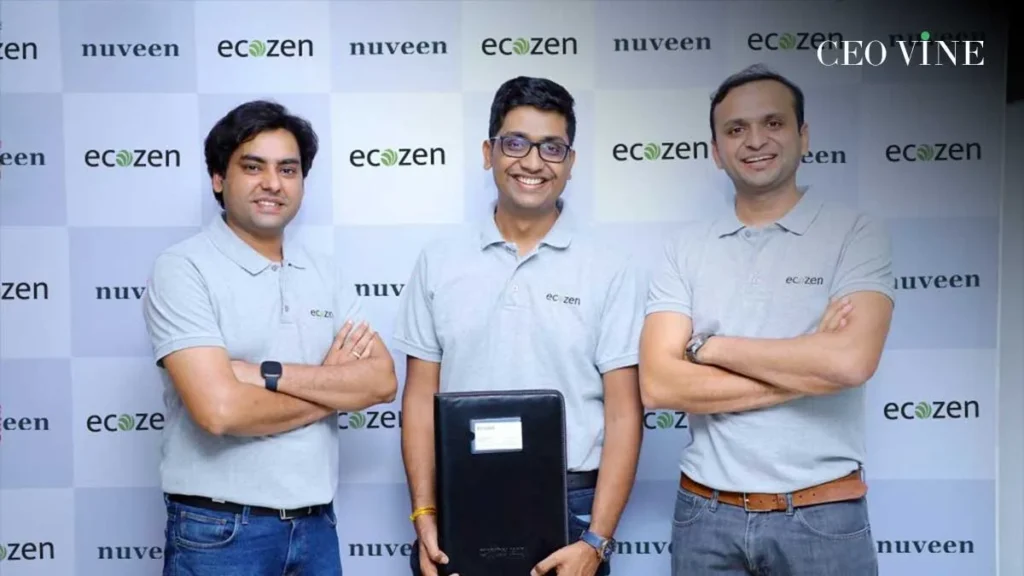
Ecozen was founded on the IIT Kharagpur campus by Devendra Gupta, Prateek Singhal, and Vivek Pandey, and has spent over a decade applying solar power, IoT, and thermal energy storage to one of agriculture’s oldest problems: spoilage. Its flagship products, Ecofrost (a solar-powered decentralised cold room) and Ecotron (a smart solar irrigation controller), have helped more than 180,000 farmers cut post-harvest losses and improve incomes.
The company’s growth has accelerated sharply. Revenue from operations rose 2.5x to ₹1,150 crore in FY25 from ₹458 crore in FY24, while profits grew nearly 5x in the same period.
Ecozen has raised over $104 million in equity and debt to date, including a $30 million round backed by Nuveen, InCred, and the U.S. International Development Finance Corporation, and was in talks for a Series D round as of late 2025. Its technology stack has cut an estimated 2 million tonnes of greenhouse gas emissions and prevented over 50,000 metric tons of food loss.
2. GPS Renewables

Founded: 2012 | Headquartered: Bengaluru
GPS Renewables was started by two IIM-Bangalore graduates, Mainak Chakraborty and Sreekrishna Sankar, as a captive biogas company before scaling into India’s leading full-stack renewable natural gas player. The company designs, builds, and operates compressed biogas (CBG), bioCNG, and ethanol plants that convert agricultural and organic waste into clean fuel, including Asia’s largest municipal solid waste-based CBG plant in Indore.
GPSR now generates annual revenue of roughly ₹961 crore and employs more than 850 people. In June 2026, it raised ₹635 crore in a Series C round, ₹125 crore in equity led by PixelSky Capital, alongside a ₹200 crore equity partnership under its asset-holding platform GPSR Arya with a Korean industrial investor.
The company has formed joint ventures with Indian Oil, Bharat Petroleum, and Oil India to build CBG infrastructure nationwide, with more than 30 projects nearing completion and over 200 more planned.
3. Freyr Energy
Founded: 2014 | Headquartered: Hyderabad
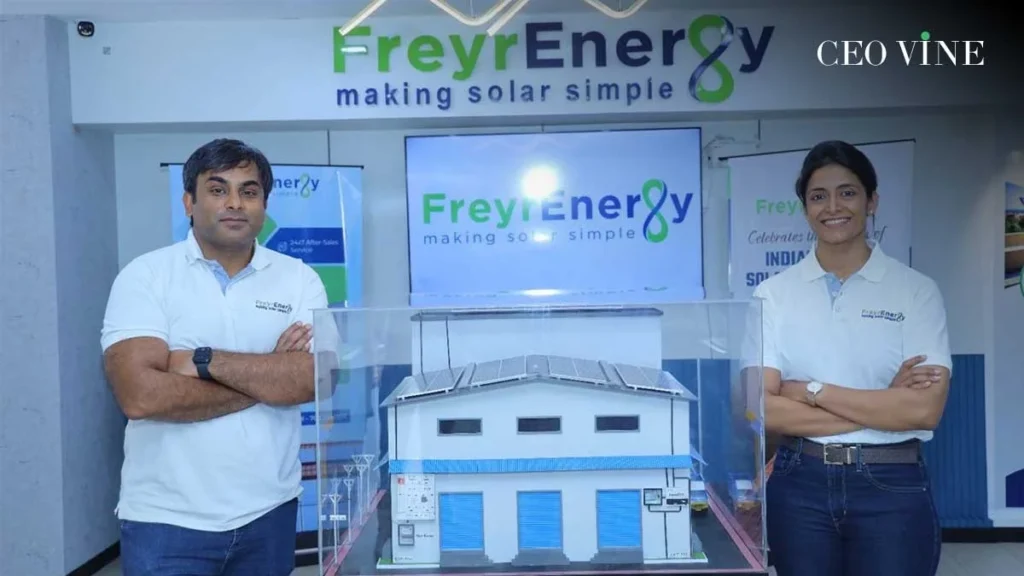
Freyr Energy was founded by Saurabh Marda and Radhika Choudary to bring rooftop solar to India’s most underserved energy customers: homeowners and MSMEs, who together consume more than half of India’s retail electricity but account for less than 2% of rooftop solar adoption. Its proprietary app, SunPro+, digitises the entire customer journey from quote to financing to after-sales service.
After installing roughly 12,000 systems in its first decade, Freyr is on pace to install more than 15,000 systems in FY25-26 alone, with a target of 30,000 in FY26-27. This massive 1,150% volume acceleration is driven by aggressive consumer demand triggered by the central government’s PM Surya Ghar: Muft Bijli Yojana subsidy scheme, which has heavily motivated households and micro-enterprises to adopt rooftop solar.
The company has raised $13.8 million across six rounds from investors including Schneider Electric, C4D Partners, and the EU-backed EDFI ElectriFI, and now operates across 22 Indian states.
4. Chakr Innovations

Founded: 2016 | Headquartered: Gurugram
Chakr Innovations was founded by IIT Delhi graduates Kushagra Srivastava and Arpit Dhupar with an unusual premise: instead of just reducing emissions, turn pollution into a product. Its flagship device, Chakr Shield, captures particulate matter from diesel generator exhaust and converts it into usable ink and coatings, reducing emissions by more than 80% while creating a sellable by-product.
The company has over 5,000 installations and 2,000+ customers across India, and has prevented more than 2.5 million tonnes of CO2-equivalent emissions to date. Chakr reported FY24 revenue of approximately ₹125 crore with a net profit of ₹9.5 crore, making it one of the rare profitable climate-tech startups in India.
In September 2025, it raised $23 million in a Series C round led by Iron Pillar, with participation from ONGC, SBI Cap Ventures, and the Indian Angel Network, to fund international expansion and R&D into aluminium-air battery technology as an indigenous alternative to lithium-ion.
5. Exponent Energy

Founded: 2020 | Headquartered: Bengaluru
Exponent Energy, founded by Arun Vinayak, builds an integrated energy stack for commercial EVs, a proprietary battery pack, ultra-fast charging station, and high-current connector engineered to charge a vehicle from empty to full in around 15 minutes. The company has spent its first five years proving the technology works reliably at scale, primarily with electric three-wheelers and, increasingly, electric buses.
Exponent now runs roughly 200 charging stations across Bengaluru and Delhi and has expanded its battery systems from 10 kWh packs for three-wheelers to 420 kWh systems for electric buses, including India’s first all-sleeper electric bus fleet with rapid charging, launched with Fresh Bus in January 2026.
The company’s total funding stands at $65.7 million, including a ₹200 crore round in June 2026 co-led by 360 ONE Asset and TDK Ventures. Annual revenue reached ₹44 crore as of March 2025.
6. Battery Smart
Founded: 2019 | Headquartered: Gurugram
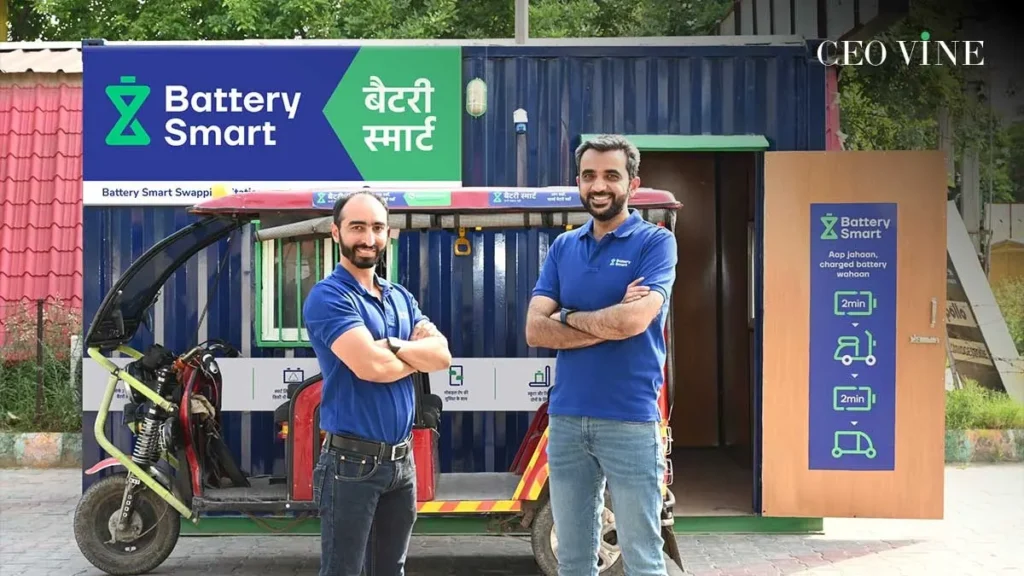
Battery Smart was founded by IIT Kanpur graduates Pulkit Khurana and Siddharth Sikka to solve a different problem in electric mobility: instead of waiting for a vehicle to charge, why not swap the battery entirely? Its partner-led network lets drivers of electric two- and three-wheelers exchange a depleted battery for a charged one in about two minutes, reducing upfront vehicle costs by up to 40% by decoupling the battery from the vehicle.
The company now operates a network of more than 1,600 swap stations across 50-plus cities, has facilitated over 100 million battery swaps, and holds an estimated 36% share of India’s battery-swapping market. Battery Smart has raised roughly $192 million to date from investors including Tiger Global, British International Investment, LeapFrog Investments, MUFG Bank, and Panasonic, with its revenue reportedly tripling in FY24 on the back of quick-commerce-driven demand for last-mile delivery fleets.
Also Read | 10 Defense Tech Startups Championing India’s Military Self-Sufficiency
7. Recykal
Founded: 2016 | Headquartered: Hyderabad
Recykal was founded by serial entrepreneur Abhay Deshpande along with Abhishek Deshpande, Anirudha Jalan, Ekta Narain, and Vikram Prabakar to formalise one of India’s most fragmented and informal industries: waste trading. Its marketplace connects waste generators such as corporates, hotels, campuses, and resident associations with recyclers and aggregators, while helping brands like Amul and Hindustan Unilever meet their Extended Producer Responsibility obligations for plastic and e-waste.
Recykal’s gross waste value has grown 3-4x annually, reaching roughly ₹745 crore in FY23, and the company has raised $40.9 million in funding from investors including Morgan Stanley, Circulate Capital, and 360 ONE Asset Management. Its “Samudramanthan” initiative aims to recover 70,000 metric tonnes of ocean-bound plastic across 207 districts in 19 states, and it is building India’s first digital deposit-refund systems for packaging.
8. Varaha

Founded: 2022 | Headquartered: Gurugram
Varaha was founded by Madhur Jain, Ankita Garg, and Vishal Kuchanur, all with backgrounds working directly with smallholder farmers to help agriculture become a carbon sink instead of an emissions source. The company runs regenerative agriculture, agroforestry, biochar, and enhanced rock weathering projects across India, Nepal, Bangladesh, Bhutan, and Ivory Coast, working with roughly 175,000 farmers to generate verified carbon removal credits sold to corporate buyers including Google, Microsoft, Lufthansa, and Swiss Re.
Varaha has removed more than 2 million tonnes of CO2 to date and was the first company in India to issue carbon credits from biochar projects. Revenue reached roughly ₹430 million last fiscal year and is projected to nearly triple this year, while the company remains profitable after tax.
The company has raised about $33 million in equity, including a $20 million tranche of a planned $45 million Series B led by WestBridge Capital in February 2026, plus a separate $30.5 million carbon-investment deal with French firm Mirova in November 2025 to expand regenerative farming across Haryana and Punjab.
9. Newtrace
Founded: 2021 | Headquartered: Bengaluru
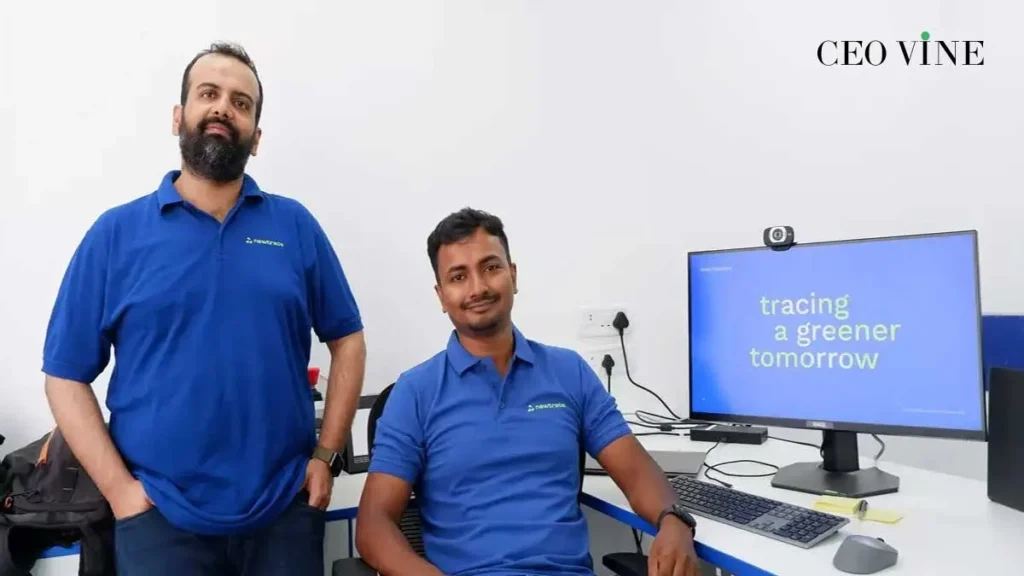
Newtrace was founded by Prasanta Sarkar and Rochan Sinha to tackle one of green hydrogen’s most stubborn cost problems: the electrode. Its proprietary Voltagen technology is a coated cathode, developed by screening more than 1,000 catalyst-substrate combinations, that slots directly into existing alkaline electrolyser stacks and cuts the specific energy consumption of hydrogen production by up to 9.5 kWh/kg with no platinum-group materials and no changes to existing plant infrastructure.
Operating out of a 30,000-square-foot Bengaluru facility with more than 45 engineers and scientists, Newtrace has raised roughly $12 million across seed and pre-Series A rounds, including a $6.3 million round led by HDFC Bank and Mitsui Sumitomo Insurance Venture Capital, with participation from Peak XV Partners’ Surge and Aavishkaar Capital. The company expects to begin commercial deliveries of Voltagen electrodes within the next year, positioning itself as a supplier to electrolyser OEMs and green hydrogen project developers as India works toward its National Green Hydrogen Mission target of 5 million metric tonnes annually by 2030.
10. Zerocircle

Founded: 2020 | Headquartered: Pune
Zerocircle was founded by former Google employee Neha Jain to replace single-use plastic with something the ocean already makes for free: seaweed. The company converts sustainably farmed seaweed from coastal communities in Gujarat, Maharashtra, and Tamil Nadu into films, coatings, and paper that are fully home-compostable and marine-degradable, designed to match the barrier performance of conventional plastic packaging used in food service and retail.
Recognised as a “minicorn” in India’s sustainability ecosystem, Zerocircle has raised $4.9 million across multiple rounds, including a ₹20 crore round in January 2025 led by Zerodha co-founder Nithin Kamath’s Rainmatter, and a follow-on ₹5 crore round a year later co-led by 3one4 Capital and Rainmatter to scale into QSR and retail packaging. The company was also the second-place winner of the Tom Ford Plastic Innovation Prize in 2022 and is targeting cost parity with conventional plastic within two years.



Trends Shaping India’s Climate Tech Sector in 2026
Capital is consolidating around scale, not stage. Late-stage deals accounted for $524 million of the $791 million raised in climate tech through the first five months of 2026, even as total deal count and early-stage cheque sizes declined. Investors are rewarding companies like Ecozen, GPS Renewables, and Chakr that have already proven commercial traction.
Waste-to-value models are replacing pure compliance plays. Chakr turns diesel soot into ink. Recykal turns scrap into a tradeable commodity. GPS Renewables turns organic waste into fuel. The most fundable climate-tech businesses in India increasingly look like profitable industrial companies first, and emissions-reduction stories second.
Carbon markets are professionalising ahead of regulation. With India’s compliance carbon market going live in October 2026 and global corporates already signing offtake deals with companies like Varaha, carbon accounting and measurement, reporting, and verification (MRV) infrastructure is shifting from a voluntary, NGO-adjacent category to investable infrastructure.
Hardware deeptech is back in fashion. After several EV-battery startups stumbled on hardware execution and corporate governance, investors like HDFC Bank and Peak XV are still backing materials-science-heavy bets such as Newtrace’s electrolyser electrodes — but with tighter scrutiny on manufacturing readiness and unit economics than the 2021–22 funding cycle.
India’s climate-tech sector has moved well past its policy-paper phase. With $12.8 billion in cumulative funding, a compliance carbon market arriving in October, and founders building everything from cold storage to carbon removal, the next wave of Indian unicorns may well be the ones nobody thought to call “tech” a decade ago.