



How Perplexity AI Became a $20 Billion Answer Engine in Just 3 Years
The company raised $1.22 billion across 9 funding rounds. In September 2025, its Series D round raised $200 million, finalizing a $20 billion valuation. Notable investors include Jeff Bezos, Nvidia, SoftBank, IVP, NEA, and Accel.

For over two decades, Google has been the gateway to information. But the experience of searching today often feels cluttered, with ads filling the first page, SEO-driven results overshadowing relevance, and users spending more time filtering than finding what they need. In this environment, a new kind of tool has started to gain attention Perplexity AI, a platform that calls itself an “answer engine” instead of a search engine.
What Is Perplexity AI?
Perplexity AI is an AI-powered, citation-based answer engine that reimagines how humans interact with information. Instead of showing multiple links like traditional search engines, it provides clear, sourced, and conversational answers. The company is headquartered in San Francisco, California, and was founded on December 7, 2022, by Aravind Srinivas (CEO), Andy Konwinski, Denis Yarats (CTO), and Johnny Ho (CSO).
The idea behind Perplexity was simple, to create a platform that delivers accurate, transparent, and ad-free answers. It has quickly gained popularity among professionals, researchers, and enterprises looking for reliable information without the noise of advertisements.
Who Is Aravind Srinivas?
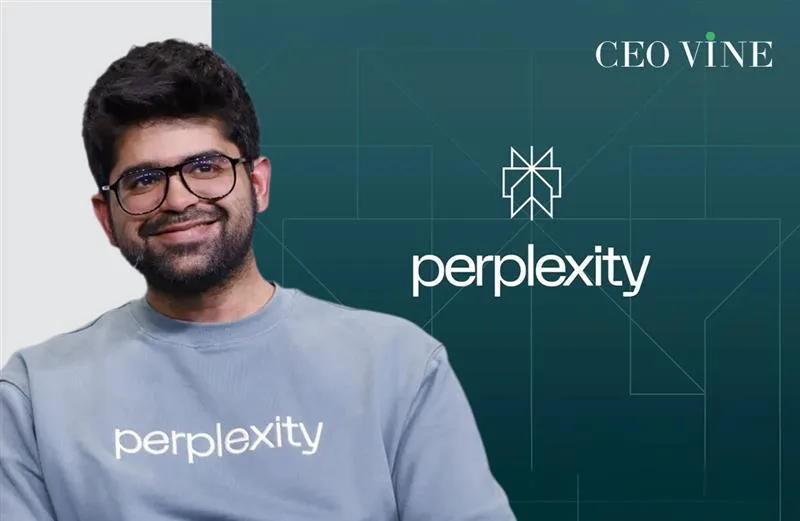
Aravind Srinivas, the co-founder and CEO of Perplexity AI, is an Indian-born technologist whose academic and professional journey has deeply influenced the company’s philosophy. He completed a dual degree in Electrical Engineering (B.Tech + M.Tech) from IIT Madras and went on to earn a Ph.D. in Computer Science from UC Berkeley.
Before founding Perplexity, Srinivas worked with leading AI research organizations, which helped him realize a critical gap in the digital information space. He noticed that while search engines had evolved technologically, they still failed to serve the user’s real intent — offering lists of links instead of direct, useful answers.
That realization led him to create an “answer engine” designed to understand questions, provide verified responses, and cite sources clearly. As Srinivas explains, “Perplexity is the fastest way to get answers to any question.”
How Perplexity AI Works
Perplexity AI uses large language models (LLMs) to gather, synthesize, and summarize information from trusted online sources. Every response includes proper citations, allowing users to verify the data themselves.
The platform stands out for its user-first approach. Unlike ad-heavy search engines, Perplexity offers a clean, distraction-free interface. Users can either explore the free version or subscribe to Perplexity Pro at $20 per month for advanced features. For organizations, an Enterprise Pro tier provides deeper AI integration and data solutions.
In addition to the main platform, Perplexity has introduced new products such as the Comet browser, Shopping Hub, and an API platform that lets developers build tools using its infrastructure.
Growth, Funding, and Valuation
Since its launch, Perplexity AI has grown at an exceptional pace. The company’s monthly queries increased from 230 million in August 2024 to 780 million by May 2025, and it surpassed 30 million monthly active users by September 2025.
Perplexity’s valuation also reflects its rapid growth. It rose from $500 million in January 2024 to $20 billion by September 2025. The company’s annual recurring revenue (ARR) reached $100 million in March 2025, with projections of $148 million by June 2025.
The startup has attracted strong investor confidence, raising $1.22 billion across nine funding rounds. In September 2025, its Series D round raised $200 million, finalizing a $20 billion valuation. Notable investors include Jeff Bezos, Nvidia, SoftBank, IVP, NEA, and Accel.
Global Collaborations and Expansion
Perplexity AI has expanded through strategic partnerships that strengthen its presence globally. The company has collaborated with Bharti Airtel in India and SoftBank in Japan, alongside hardware partnerships with Deutsche Telekom and Motorola. There are also potential integrations with Samsung, which could bring Perplexity’s assistant directly onto user devices.
These partnerships, combined with its growing suite of products, show the company’s intent to go beyond being just a web-based tool — aiming to become an embedded AI layer across platforms.