



How India’s EV Startups Are Competing With Legacy Auto Makers
Two years ago, Ola Electric owned nearly 40% of India's electric two-wheeler market and legacy automakers looked flat-footed. In 2026, the story has almost completely reversed.


Few stories in Indian business capture a reversal of fortune as sharply as the electric two-wheeler race. In January 2024, Ola Electric commanded nearly 40% of India’s electric two-wheeler market, four out of every ten electric scooters registered in the country carried its badge. By early 2026, that number had collapsed to under 6 percent. This is not a story about EV demand slowing down, the category grew strongly through this entire period. It is a story about execution, and about what happens when legacy manufacturers decide to stop watching from the sidelines.
Ola Electric’s Fall From Near-Total Dominance
Ola Electric, founded by Bhavish Aggarwal, built its early lead through aggressive pricing and rapid retail expansion, at one point planning to operate 4,000 stores nationwide. That strategy delivered scale fast but appears to have come at the cost of service quality. Persistent customer complaints about slow service, delivery delays, and unreliable after-sales support steadily eroded consumer trust, even as the broader electric two-wheeler market kept growing at 20 to 25 percent annually.
The financial numbers tell the story starkly. Ola’s electric two-wheeler deliveries fell to roughly 1.73 lakh units in FY26 from 3.07 lakh the year before, and its market share slid from over 36 percent in 2024 to around 16 percent in 2025, then further down to roughly 4 to 6 percent by early 2026.
The company has since undertaken what it calls a structural reset, cutting its retail footprint down to around 550 stores from earlier ambitions and posting its first cash-flow-positive quarter in Q4 FY26, alongside its highest-ever automotive gross margin of 38.5 percent. Whether that operational discipline can rebuild the trust it lost is the open question hanging over the company heading into the rest of 2026.
Legacy Automakers Turned Their Distribution Advantage Into an EV Advantage
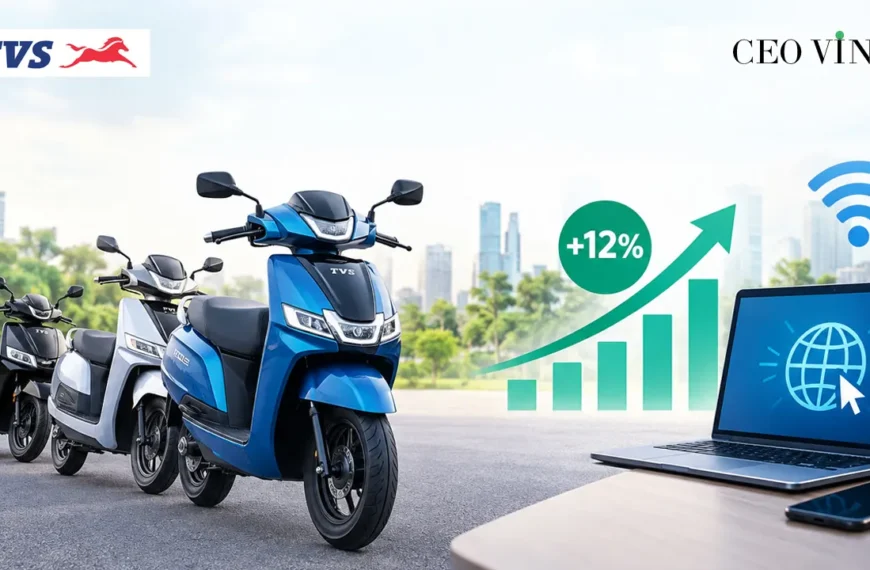
While Ola stumbled, TVS Motor Company and Bajaj Auto did something legacy companies are rarely given credit for: they moved fast. TVS emerged as the electric two-wheeler market leader through 2025 and into 2026, holding roughly 24 to 28 percent share depending on the month, powered by its iQube scooter.
Bajaj Auto followed closely with its Chetak line, holding around 21 to 23 percent share. Hero MotoCorp, historically slower to enter the EV race, nearly doubled its share from under 4 percent to close to 9 percent over the same period.
The reason these legacy players gained ground so quickly comes down to something no pure-play EV startup can easily replicate: an existing, dense service and dealership network that spans every district in the country. When a scooter breaks down or needs a service appointment, proximity to a trusted dealer matters enormously to an Indian buyer, and that is precisely where Ola’s aggressive but thinly staffed retail expansion fell short against incumbents who already had decades of distribution infrastructure in place.
Ather Energy: The Startup That Adapted
Not every EV startup lost ground. Ather Energy, co-founded by Tarun Mehta, has been the clearest counterexample to Ola’s decline. Ather’s market share climbed from around 11 percent in 2024 to roughly 17 to 18 percent through 2025 and into 2026, driven substantially by its Rizta scooter, a more family-oriented, mass-market product than Ather’s earlier premium-only positioning. Ather’s FY26 sales rose nearly 70 percent year on year to 2.63 lakh units, and the company narrowed its EBITDA losses meaningfully, moving from around negative 19 percent to closer to negative 3 percent.
Mehta has been notably vocal about keeping Ather’s reported numbers clean of subsidy-driven distortions, a pointed contrast to public sparring with Aggarwal over how each company’s unit economics should actually be read. Ather is reportedly evaluating a fresh capital raise in mid-2026 to fund infrastructure expansion, including its charging network, and is positioning itself for an eventual IPO, having already reached unicorn status.

What This Reversal Actually Teaches Founders
The lesson embedded in this story goes well beyond electric vehicles. A fast-growing market and an early lead are not the same thing as a durable moat. Ola Electric had both scale and a head start, and lost meaningful ground within two years because service quality and distribution depth, unglamorous, operationally heavy parts of the business, turned out to matter more to Indian consumers than early pricing advantages or brand buzz.
Legacy companies, often assumed to be too slow or too encumbered by their existing combustion-engine business to compete with agile startups, proved capable of using their existing infrastructure as a genuine competitive weapon once they committed to taking EVs seriously. For founders building anything that depends on after-sales trust, whether that’s automobiles, appliances, or any physical product with a service component, this is close to a textbook case study in why distribution and service depth can outlast a head start built on price and marketing alone.
India’s broader EV market continues to grow strongly, passenger EV sales were up over 70 percent year on year through early 2026, supported by government incentives like the PM E-DRIVE subsidy. But the competitive order within that growth has been rewritten entirely, and the next chapter will likely be decided by which companies, startup or legacy, can convert growing sales into genuinely sustainable unit economics rather than share gained through discounting alone.