



How Indē Wild Took A Decade-Long Skin Battle And Built A Global Ayurvedic Beauty Brand
The Diipa Büller-Khosla brand has raised nearly $8 million, grown sales 400% in India, and is targeting ₹1,000 crore in revenue within three years.


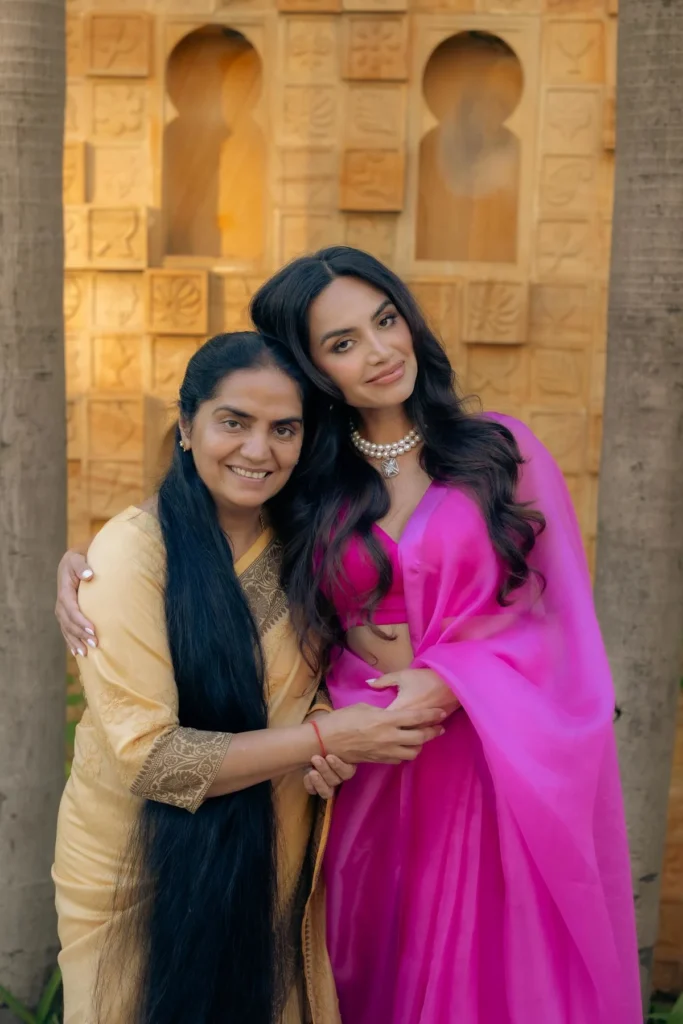
For ten years, Diipa Büller-Khosla struggled with acne that nothing seemed to fix. She tried the products that were widely recommended, the routines that worked for other people, the dermatology-approved standards of the Western beauty industry she had access to as a model and influencer with millions of followers. None of it solved the problem. What did, eventually, was her own mother, an Ayurvedic doctor, who treated her skin using a combination of Ayurveda and chemistry that Diipa had grown up around but never thought to take seriously as a commercial idea.
When she looked for a beauty brand on the market that did the same thing her mother had just done for her, she could not find one. So in October 2021, she built it herself.
That brand is Indē Wild, and the gap it identified turned out to be larger than one founder’s decade of frustration. It was a gap in the entire category.
Indē Wild – A Name Built From Two Ideas
The name itself carries the brand’s founding logic. Indē is a play on independence and India. Wild refers to the herbs of Ayurveda that grow in the wild, the raw, untamed source material the brand draws from before it ever reaches a lab. Together, the name was built to represent a community of independent women navigating a very specific duality: raised on the wisdom passed down by mothers and grandmothers, while living modern lives shaped by science, ambition, and global culture.
“I wanted to create a brand that married the principles of natural medical science with the finest Ayurvedic superfoods and conscious revolutionary chemistry,” Diipa Khosla has said of the brand’s founding intent. The company coined its own term for this approach: Ayurvedistry, a trademarked blend of the words Ayurveda and chemistry, describing formulations that pair centuries-old Indian botanicals with clinically studied active ingredients.
Before launch, the brand did not simply formulate based on instinct. The team interviewed thousands of women, and later expanded that research into more than 60 focus groups across its key markets, to understand skincare needs that the wider industry had largely ignored, particularly among melanated and South Asian skin types prone to hyperpigmentation and environmental damage that most mainstream skincare formulations were never designed to address.
The first products took two years to finalise. The brand’s debut Vitamin C and Bakuchiol serums went through roughly 43 and 21 formulation versions respectively before Diipa Khosla considered them ready, a level of iteration unusual for a debut product line, but consistent with the brand’s stated refusal to treat Ayurveda as a marketing aesthetic rather than an actual formulation discipline.
Backed By Science, Not Just A Founder’s Name
Indē Wild’s credibility does not rest on Diipa Khosla’s public profile alone. The brand operates with a board that includes five women: dermatologists, Ayurvedic doctors, and scientific researchers, whose role is to ensure that the brand’s products hold up to clinical scrutiny rather than functioning purely as a wellness narrative. Diipa Khosla’s own mother, the Ayurvedic doctor who treated her acne and shaped her understanding of the discipline from childhood, remains a central influence on the brand’s formulation philosophy.
The company’s flagship product, Champi Hair Oil, became the clearest signal that this approach was resonating commercially rather than just narratively. The product became the number one bestseller on Nykaa, India’s leading beauty platform, outperforming established global players including Olaplex and L’Oréal, and at its peak was selling at a rate of one unit every minute.
The Funding Trajectory
Indē Wild’s capital history tracks closely with the milestones that validated its thesis. The brand closed a seed round of just over $3 million in 2022, within months of its initial launch, led by SoGal Ventures, at a valuation of close to $30 million. The round was unusual for how early it arrived, and came despite Diipa Khosla noting that several investors had initially dismissed the brand as too small or too niche for the category it was trying to build.
Three years later, in March 2025, the brand closed a $5 million seed extension led by Unilever Ventures, the corporate venture arm of one of the world’s largest consumer goods companies, with continued participation from SoGal Ventures and True Global Ventures.
The round followed a period of exceptional growth: 400% year-on-year sales growth in India over 18 months, alongside roughly 500% global retail growth, and a confirmed retail partnership with Sephora that had, by the founders’ account, approached Indē Wild rather than the other way around.
Total funding raised across the company’s rounds stands at approximately $8 million, a relatively modest base of institutional capital set against the scale of growth and retail distribution the brand has achieved in the years since its founding.
From Nykaa To Sephora US
Indē Wild’s retail trajectory has moved deliberately from India outward. The brand built its initial traction through Nykaa and, later, Tira, becoming, by its own and independent reporting, one of the fastest-growing premium hair and skin brands on both platforms. It was named one of eight brands in Sephora’s 2024 Accelerate program, a cohort designed to fast-track promising independent beauty brands into Sephora’s retail ecosystem.
That relationship deepened steadily. Indē Wild launched into Sephora UK in late 2024, and in March 2026, the brand officially launched on Sephora.com in the United States, followed by an in-store rollout across 178 select Sephora US locations. The launch was framed internally as a defining moment in the brand’s evolution: from a digitally native community brand to what the company describes as a global prestige beauty label.
“From day one, we built Indē Wild around the belief that Ayurvedic wisdom and clinical science can coexist in a way that feels both elevated and accessible,” Diipa Khosla said of the Sephora US debut. Co-founder Oleg Büller, who joined Diipa Khosla in running the company, has described the brand’s pitch to retail partners and investors in similarly direct terms: “We’re merging heritage with now, and owning both.”
According to the founders, the response from Sephora’s own team reinforced that positioning. A Sephora vice president reportedly told them the brand stood out specifically because of its authenticity in a category where, in the executive’s words, most brands look, smell, and feel the same.


The Market Behind The Momentum
Indē Wild’s growth has tracked alongside a broader structural shift in how Indian and South Asian consumers think about Ayurvedic beauty. The India Ayurvedic skincare market was valued at approximately $1.8 billion in 2024 and is projected to reach $5.4 billion by 2033, growing at a CAGR of around 13%, according to IMARC Group. The wider Indian Ayurvedic products market, spanning skincare, haircare, and beyond, was valued at $9.9 billion in 2024 and is projected to reach $41.1 billion by 2033, growing at over 16% annually.
What is shifting is not just the size of the market but the perception attached to it. Ayurveda in skincare was, for years, associated with an older, less aspirational consumer base. Indē Wild has built its entire brand identity around reversing that association, positioning Ayurvedic ingredients as performance-driven and scientifically credible rather than traditional in a nostalgic sense, a repositioning that appears to be resonating particularly with younger, digitally native consumers across both India and its diaspora markets in the US and UK.
The brand’s stated ambition reflects the scale it believes this shift can support. According to reporting on the company’s growth plans, Indē Wild is targeting roughly ₹1,000 crore in revenue within three years, driven jointly by continued momentum in India and accelerating growth in the US market following the Sephora launch.
What The Story Signals
Indē Wild’s path from a personal skincare struggle to a globally distributed beauty brand is, on its surface, a familiar founder narrative: a problem nobody else was solving, built by someone with the visibility to be heard once she did. But the more durable part of the story is what the brand did after the initial attention, choosing to build out a scientific board, run extensive consumer research before formulating a single product, and spend two years and dozens of iterations getting two serums right before launching anything at all.
That discipline appears to be what convinced Unilever Ventures, Sephora, and a base of consumers across three continents that Ayurveda was not a heritage story being repackaged for retail shelves, but a genuine formulation approach capable of competing directly with the categories it was once assumed to sit outside of.
Indē Wild is headquartered in Mumbai, India, and is available on indewild.com, Nykaa, Tira, Sephora UK, and Sephora US.