



How EMotorad Built India’s Largest Electric Cycle Brand Out Of A Stuck Shipment
EMotorad has raised over $26 million, grown revenue to ₹143 crore in FY24, and built a 70% share of India's e-cycle market.


In 2020, a container of high-end electric bikes bound for the United Kingdom got stuck. The pandemic had shut down ports, frozen logistics networks, and left a small Pune-based team holding inventory they had nowhere to send. Most founders in that position would have waited it out. Kunal Gupta and his co-founders decided to sell the bikes locally instead, almost as an improvisation to recover some cash while the world figured out what was happening.
That improvisation became EMotorad. Five years later, the company holds roughly 70% of India’s electric bicycle market, exports to 18 countries, and is building what it describes as the largest integrated electric cycle gigafactory outside China.
A Founder Who Had Already Seen This Problem Before
Kunal Gupta did not arrive at EMotorad as a first-time founder chasing a trend. Years earlier, living on the outskirts of Pune around 2014, he had noticed a basic transportation gap, particularly for students, in a city where ride-hailing apps like Ola had not yet become commonplace. That observation led him to co-found ONN Bikes (also referred to in early coverage as OnBike) in 2015, a two-wheeler rental service that eventually scaled to more than 14,000 vehicles across 11 cities, run in a model similar to what Zoomcar would later popularise for cars. Before that, Gupta had built and exited an even earlier venture, MyRide, a bike rental business aimed at college students.
By 2016 and 2017, Gupta had teamed up with Rajib Gangopadhyay, and the two began thinking seriously about electric mobility as the next logical step. Sumedh Battewar, originally a vendor supplying IoT components to their earlier ventures, and Aditya Oza joined as the founding team came together. The four co-founders concluded that electric mobility was where transportation was headed, and that India, despite being one of the largest cycling markets in the world, had almost no domestic manufacturing capability in the category. Nearly everything available was imported from China.
EMX, the company’s flagship product, launched in August 2020. The company was incorporated as EMotorad the same year.
EMotorad – Building What India Was Importing
The founding insight behind EMotorad was straightforward: India was sitting on a $40 billion global e-bike opportunity that almost no one in the country was positioned to capture, because the supply chain for batteries, motors, and componentry had been ceded almost entirely to China.
“Almost 99% of the world procures e-bikes from China, and that is what we want to change,” Kunal Gupta has said. “It’s a $40 billion industry internationally, and we are trying to make a dent in that.”
The company’s early traction validated the thesis faster than expected. Within roughly a year of EMX’s launch, EMotorad reported having over 2,000 e-bikes already on Indian roads and clients spread across 58 countries, an unusually international footprint for a company barely a year old. The product range was built around affordability without sacrificing specification, targeting a market segment where features common in premium imported e-bikes had previously been out of reach for the average Indian consumer.
EMotorad expanded its global presence in earnest from 2021 onward, eventually exporting to more than 18 countries through a combination of white-labelling arrangements and its own branded models. The export business became a defining part of the company’s identity, not a secondary channel bolted on after establishing itself domestically.
EMotorad Funding and Investors
EMotorad’s profile rose further with the involvement of former Indian cricket captain M.S. Dhoni, who came on board as both an investor and a brand endorser. The association proved to be a recognisable shorthand for the brand in the Indian market.
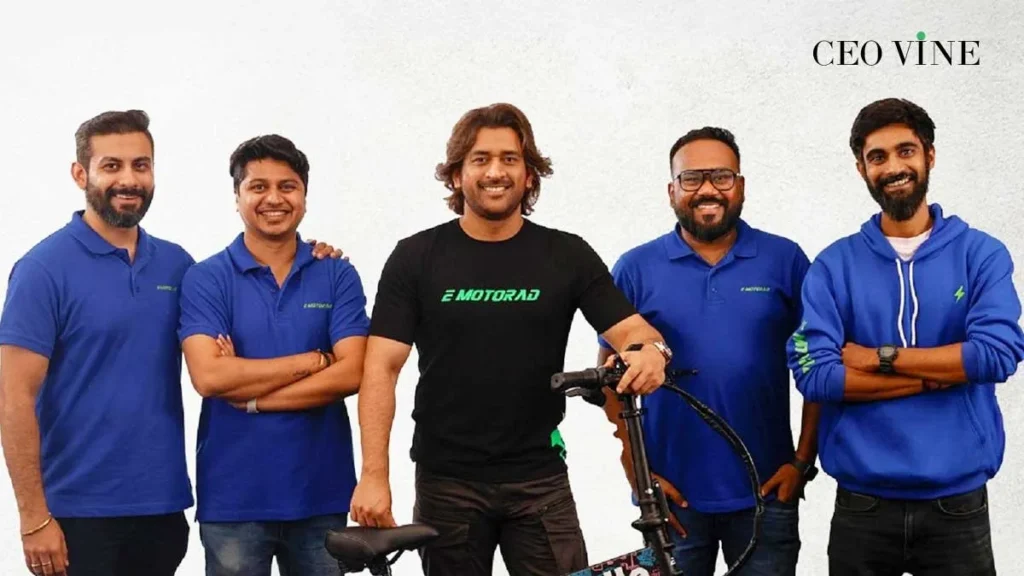
“Everyone asks, ‘yeh MS Dhoni wali cycle hai na’,” Kunal Gupta has said, referring to how customers commonly identify the brand simply as the cycle that Dhoni is associated with.
The company’s institutional fundraising history reflects steady, staged growth in investor confidence. EMotorad raised an early seed round backed by LetsVenture and Green Frontier Capital in 2022, before closing a $20 million Series B round in November 2023 led by Panthera Growth Partners, with continued participation from Alteria Capital. Total funding raised across the company’s rounds stands at approximately $26 million as per sources.
The Gigafactory Bet
In 2024, EMotorad announced plans for what it describes as the world’s largest integrated electric cycle gigafactory, a 240,000 square foot facility in Pune being developed in four phases. On completion, the facility is expected to produce up to 500,000 e-cycles annually, manufacturing not just finished bikes but the core components, battery packs, motors, displays, and chargers, under one roof.
“The mission is to make from India for the world,” Kunal Gupta said of the decision.
The integrated approach is intended to improve quality control, reduce production costs, and shorten supply chains, while directly supporting India’s broader Make in India manufacturing push. Upon completion, the facility is positioned to be the largest e-cycle manufacturing site outside China.
Growing Fast, Spending Faster
EMotorad’s financial trajectory tells a story of a company scaling aggressively while still working toward profitability. The company’s operating revenue rose nearly 17% to ₹143.59 crore in FY24, up from ₹124.51 crore in FY23, with roughly 70% of that revenue coming from local and B2B partnerships, according to cofounder Rajib Gangopadhyay. Total expenses grew faster than revenue, climbing 31% year-on-year to ₹176.42 crore, driven primarily by the cost of raw materials, which rose to ₹129.88 crore for the year. Net loss widened to ₹30.54 crore in FY24, up from ₹9.73 crore in FY23, reflecting the cost of scaling manufacturing capacity and international distribution simultaneously.
It is a familiar pattern for a hardware company investing heavily in domestic manufacturing infrastructure while expanding its export footprint, prioritising market share and production capability over near-term margins.


Navigating A Trade Shock
EMotorad’s international ambitions ran into a significant obstacle in 2025, when the United States raised import duties on Indian e-bikes from a negligible rate to 50%. The company had built a meaningful share of its export business around the US market, with more than ₹100 crore of a planned ₹150 crore in exports for the year originally earmarked for American customers.
“Prior to the 1st of April, we were sitting at a negligible zero duty structure as compared to what tariffs have done today,” Kunal Gupta said. “It has reached a 50 percent price point, which will impact consumers in the USA and sales. It is a big hit for companies like us.”
Rather than absorbing the cost or scaling back exports altogether, the company pivoted its international strategy toward Europe and Australia, while also exploring overseas assembly options as a way to reduce exposure to the new tariff structure.
What The Market Looks Like From Here
EMotorad operates in a market with real structural tailwinds behind it. The global e-bike market was valued at approximately $57.5 billion in 2025 and is projected to grow to $193 billion by 2034 at a CAGR of over 14%, according to Fortune Business Insights, with Asia Pacific accounting for the majority share of global volume.
India’s domestic e-bike market remains comparatively small in global terms, but multiple market estimates place it on a trajectory from under $1 billion today toward $2 to $4 billion by the early 2030s, driven by urbanisation, supportive government policy on electric mobility, and a consumer base increasingly receptive to alternatives beyond cars and traditional two-wheelers.
EMotorad’s position within that market is unusual in that its growth has been driven as much by exports as by domestic demand, a structure that has made the company more exposed to international trade policy than most of its India-focused peers, but has also given it a global customer base and brand recognition that few Indian electric mobility companies have managed to build at a similar stage.