

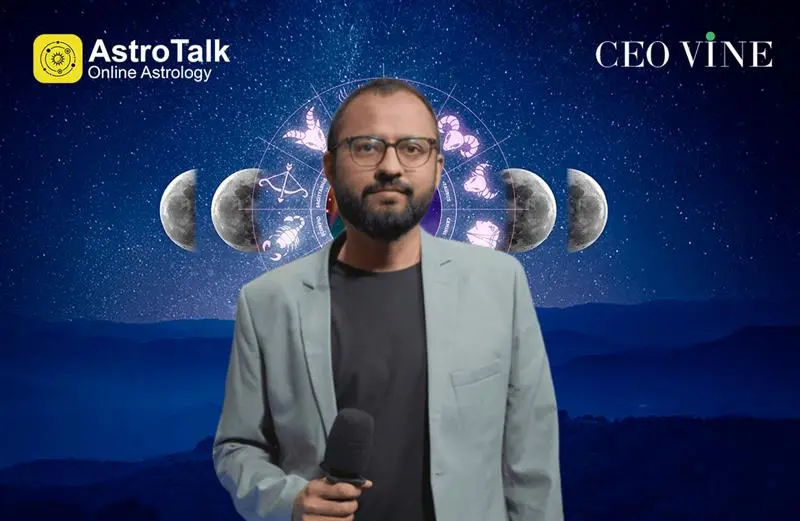
Astrology in India has long been a matter of faith and tradition — newspaper horoscopes, temple priests, and whispered predictions. But in the past decade, that quiet belief system has gone digital. The smartphone era, online payments, and India’s comfort with remote consultations have created fertile ground for a new kind of business: spiritual-tech.
And leading this transformation is AstroTalk founded by Puneet Gupta, a Noida-based astrology and spiritual-tech startup that has turned age-old practices into one of India’s fastest-growing digital businesses.
In FY24, AstroTalk recorded ₹651 crore in revenue (≈ $78 million) and ₹100 crore in profit, a twelvefold increase from the previous year. By FY25, reports suggest the company doubled again to ₹1,200 crore in revenue and ₹250 crore in profit. With more than 60 million users, 13,000 verified astrologers, and a valuation approaching $1 billion, AstroTalk now commands an estimated 80% of India’s online astrology market.
Its story isn’t just about numbers. It’s about a founder who went from rejecting astrology to building the world’s largest platform for it and in the process, redefined how technology can bring credibility and convenience to one of the world’s oldest belief systems.
The Moment That Changed Everything
Puneet Gupta didn’t start out believing in astrology. A graduate of Punjab Engineering College, he built his career as an analyst at Nomura Services and BNP Paribas before diving into entrepreneurship. In 2015, he launched an IT services startup called CodeYeti and like most first-time founders, he was confident it would work.
But two years earlier, an astrologer colleague had told him that his business would shut down within two years. At the time, Gupta laughed it off. When CodeYeti actually collapsed in 2017, the prediction hit him hard.
“That moment shook my rational side,” Gupta later said in interviews. “I realized maybe there was something in astrology we didn’t understand, maybe it wasn’t all superstition.”
That spark became the foundation for AstroTalk. He wanted to create a platform that connected people with authentic astrologers, free from fraud and guesswork, and make it as easy as booking a cab or ordering food online.
With the help of co-founder Anmol Jain, Gupta launched AstroTalk on October 18, 2017, bootstrapped from his personal savings and run initially with just one astrologer.
Building Trust in a Doubtful Market
Online astrology wasn’t new, but it had a reputation problem. Too many sites were filled with unverified astrologers, generic predictions, and fake testimonials. Gupta knew that if AstroTalk had any chance of working, trust had to be its foundation.
The company introduced a five-step verification process for astrologers, including background checks, credential verification, live tests, and ongoing quality audits. Only a small fraction of applicants were accepted.
This focus on authenticity struck a chord. Users could chat, call, or video consult with astrologers 24/7, and the conversations felt personal, private, and secure. The platform built transparency into its reviews and pricing, letting users rate each session and it’s a big step away from the opaque offline model.
By 2019, AstroTalk had onboarded over 125 astrologers and was gaining traction purely through organic growth, no funding, no flashy ads. The timing couldn’t have been better: India’s post-Jio internet boom and UPI payment systems made it easier for anyone, anywhere, to access digital consultations.
AstroTalk – The Tech Behind the Trust
AstroTalk has built a scalable technology infrastructure that can handle over 10,000 concurrent live sessions with near-perfect call success rates. The platform supports chat, voice, and video consultations and stores call histories securely.
The app uses AI-driven features like horoscope match recommendations and predictive analytics, but it doesn’t replace human astrologers, it amplifies them. Technology makes the experience seamless, but authenticity remains the brand’s anchor.
Over time, the brand expanded beyond astrology into related verticals: tarot reading, numerology, Vastu consultation, matchmaking, daily horoscopes, and personalized calculators. It later launched the AstroTalk Store, an e-commerce arm selling certified gemstones, spiritual remedies, and puja items that added a new revenue stream.
By FY24, the store alone was generating ₹10–15 lakh in daily revenue and is projected to contribute 25–30% of total revenue in the coming years.
The Growth Curve
From 2017 to 2021, AstroTalk ran on grit. Then came capital.
- Seed Round (2021): $811K from QED Innovation Labs.
- Series A (Feb 2024): $20 million led by Left Lane Capital, a New York–based VC firm.
- Series A Extension (Apr 2024): $9.5 million from existing investors, including Elev8 Venture Partners.
In total, the startup has raised about $30.3 million. The funds went toward regional expansion, hiring, and global growth particularly in the US, UK, Canada, Australia, and the Middle East.
In mid-2025, AstroTalk entered talks for a $50 million funding round that could value the company at over $1 billion, effectively making it a unicorn.
Around the same time, a proposed $100 million deal with Hornbill Capital fell through after due diligence flagged user-generated “inappropriate content.” Gupta and Jain denied any formal deal was signed, but the episode underscored one of the challenges of scaling a user-driven platform: content moderation.
The brand also appointed Deepak Khetan as CFO in 2025 a move that signals readiness for an IPO, likely around 2026.
A Global Spiritual-Tech Platform
AstroTalk’s dominance in India is staggering with an estimated 80% share of the online astrology space but its global ambitions are just beginning. The company already serves users in Sri Lanka, Australia, the US, and the UK, with localization efforts in progress.
Interestingly, about 20% of its FY24 revenue came from international users.
Competitively, AstroTalk sits atop a crowded market. Startups like AstroYogi, InstaAstro, GaneshaSpeaks, AstroSure, and Bodhi vie for attention. While there are roughly 265 active competitors in India’s online astrology and spiritual-tech category, only a handful are funded and AstroTalk remains the clear market leader.
In 2025, AstroTalk began expanding into offline retail, starting with stores in the Delhi-NCR region. The goal is to combine digital convenience with a physical experience, giving users a place to meet astrologers in person or buy authentic spiritual products.
Puneet Gupta has also hinted at acquisitions in related areas such as meditation, wellness, and self-improvement, aiming to position AstroTalk as a broader spiritual-tech ecosystem.
Why AstroTalk Works
A closer look at AstroTalk’s playbook reveals three key levers:
- Authenticity at Scale: The multi-step astrologer vetting process created a quality moat. Users come for the trust, not just the convenience.
- Emotional Connection: While AI and automation have entered the wellness space, AstroTalk kept the human layer — real astrologers guiding real people through real issues.
- Financial Discipline: Unlike many startups chasing vanity metrics, AstroTalk stayed profitable early. Its cost controls, smart marketing spends, and high repeat usage gave it strong unit economics.
For all its success, AstroTalk operates in a delicate space — one that sits between belief and business. The company has faced the challenge of moderating astrologers’ language, ensuring predictions don’t veer into harm, and maintaining cultural sensitivity across countries.
Gupta acknowledges that risk: “Astrology is powerful, but it’s also personal. We have to handle people’s emotions with care,” he said in an interview. That’s why AstroTalk keeps a close watch on consultations, maintains user-reporting tools, and enforces strict ethical guidelines for its astrologers.
The platform’s growth has also invited scrutiny. Some critics question whether digital astrology commodifies belief. But AstroTalk’s defenders argue that it’s democratizing access — offering clarity, hope, and guidance to millions who might otherwise be scammed or misled offline.
The company plans to expand internationally, targeting markets in the US, Canada, and Europe. It also aims to grow its D2C e-commerce vertical for gemstones and puja products, launch more regional-language content, and pursue an IPO by 2026.
Conclusion
Eight years ago, Puneet Gupta laughed off astrology. Today, his company defines the future of it.
AstroTalk’s rise from a bootstrapped idea to a billion-dollar business captures a larger story — of how Indian startups are fusing ancient traditions with digital innovation, and how technology, when built on trust, can reshape entire belief systems.
Whether you see astrology as faith, science, or self-reflection, AstroTalk proves one thing: even the oldest traditions can thrive in the modern world — if you build them for it.
